
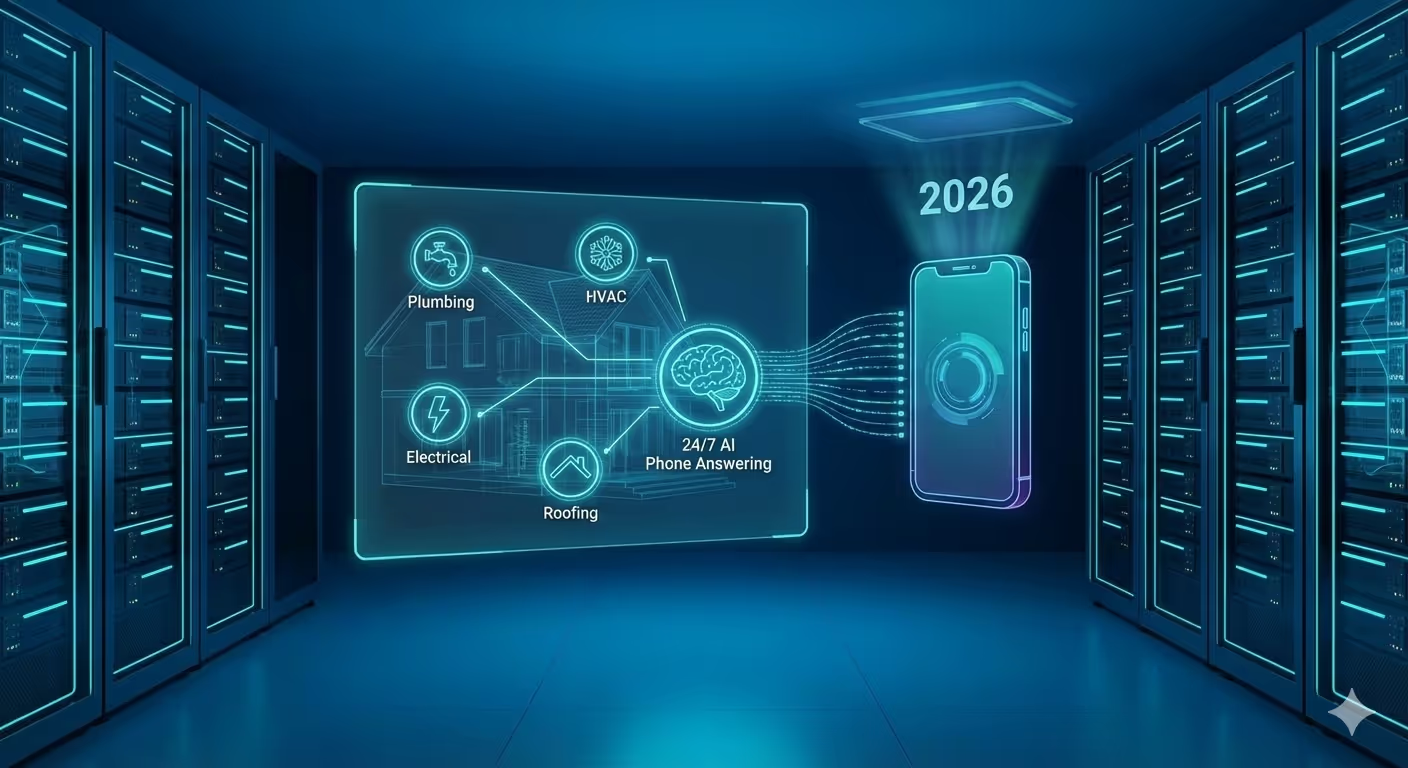
Most home service businesses lose about 27% of their incoming calls. That's not a typo according to industry data, roughly one in four calls goes unanswered. For a contractor getting 20 calls daily, that's 168 potential customers every month who never get through.
The worst part? These aren't just missed messages. 85% of callers who reach voicemail don't bother leaving one. They move on to the next contractor immediately. When someone has a plumbing emergency at midnight or their AC dies during a heatwave, they're not waiting around; they're booking whoever picks up first.
But here's the painful truth: 85% of callers who reach voicemail don't leave a message. They simply call your competitor. When water is flooding a basement or an AC unit fails during a heatwave, customers aren't patient. They need help now, and whoever answers first wins the job.
How much money am I losing from missed calls?
The numbers are staggering. Each missed call costs home service businesses an average of $1,200 in potential revenue. But that's just the immediate loss.
Let's break down what you're really losing:
A standard service call might generate $275 in revenue, but after-hours emergencies average $450-600. These aren't just one-time transactions either. Customers remember who saved them during their crisis, often becoming loyal clients worth thousands in lifetime value.
A typical plumbing business receives 8-12 emergency calls weekly outside business hours. Miss those calls, and you're potentially leaving $247,000 in annual revenue on the table. For HVAC companies, electricians, and other contractors, the numbers are equally dramatic.
The math gets worse when you factor in wasted marketing spend. You're paying for Google ads, SEO, and local listings to generate those calls. When 27% go unanswered, you're literally throwing marketing dollars away while your competitors capture the leads you paid to generate.
What happens when customers can't reach my business?
The damage goes beyond lost revenue. When customers can't reach you, several things happen and none of them are good:
They call your competitor immediately: According to research, 85% of callers who can't reach a company on the first try won't call back. They've already moved to the next name on their search results.
Your reputation takes a hit: Customers expect businesses to be available, especially for emergency services. Unanswered calls signal disorganization or unreliability. More than 60% will stop doing business with a company after a single bad experience.
Negative reviews start appearing: Frustrated customers share their experiences online. "Called three times, no answer" becomes a one-star review that damages your local SEO and drives away future customers.
Emergency opportunities disappear: High-margin emergency work goes elsewhere. Someone will answer that 11 PM call about a broken furnace in January if not you, then your competitor who's capturing your market share.
Why is 24/7 availability so important for contractors?
Emergency calls represent your biggest opportunity. When someone's pipes burst at midnight or their AC fails during a heatwave, timing is everything.
Here's what makes after-hours calls so valuable:
Premium pricing: Emergency work commands higher rates. Customers understand urgency pricing and are willing to pay $450-600 for problems that can't wait until morning.
Customer loyalty: People remember who helped them in a crisis. That midnight plumbing call often turns into a customer who calls you first for every future need routine maintenance, upgrades, and referrals to neighbors.
Competitive advantage: Most contractors rely on voicemail or personal cell phones for after-hours coverage. When you're the one business that actually answers, you stand out dramatically.
Market capture: While competitors sleep, you're capturing market share. Every answered call is a lead your competition never even knew existed.
Yet most home service businesses lose this opportunity. Relying on personal cell phones burns out your team. Voicemail loses 85% of callers. Traditional answering services can't schedule appointments or access your systems.
How does AI phone answering work for home service companies?
Modern AI phone answering systems have evolved far beyond simple voicemail. They're intelligent virtual assistants that handle calls exactly like trained receptionists but without breaks, vacations, or sick days.
Here's what happens when a customer calls:
Instant professional greeting: The AI answering service picks up within seconds, greeting callers with your company name and a natural, friendly voice. No robotic tones these systems use advanced voice AI that sounds human.
Smart conversation: The system asks the right questions to understand their needs. Burst pipe? It recognizes the urgency. Routine maintenance? It captures details for later follow-up. The AI adapts its responses based on what the customer says.
Real-time scheduling: For automated appointment scheduling, the system checks your calendar availability and books appointments instantly. Customers get confirmation texts immediately, and the appointment syncs to your schedule.
Emergency routing: True emergencies get escalated. The AI can identify urgent situations requiring immediate dispatch and transfer calls to on-call technicians or send priority alerts.
Complete documentation: Every call detail contact information, problem description, location, preferred timing gets captured and delivered in organized formats. All recordings and transcripts are saved for review.
CRM integration: Everything syncs automatically. Whether you use ServiceTitan, Jobber, or another system, call data flows directly into your CRM without manual entry.
Can AI really replace a human receptionist?
Forget replacement. The challenge is proving that the team of AI and intelligent automation achieves superior outcomes compared to any other approach.
Consider the options:
Full-time receptionist: Costs $35,000-45,000 annually, plus benefits. They work 40 hours weekly, leaving 128 hours uncovered. You'd need 4-5 people for true 24/7 coverage, costing $150,000+ per year.
Traditional answering service: Human operators take messages but can't access your systems, check availability, or schedule appointments. You spend hours daily returning calls and playing phone tag.
Personal cell phone: You're always on call, never disconnected from work, and frequently interrupted during family time or while on job sites. Burnout is inevitable.
AI phone answering: Works 24/7 for $100-500 monthly depending on call volume. Schedules appointments, updates your CRM, qualifies leads, and handles routine questions all without supervision.
The ROI comparison is clear. If AI phone answering converts just 10 additional calls monthly at $300 average ticket value, that's $36,000 in annual revenue. For most contractors, the system pays for itself within the first week.
But it's not about replacement, it's about augmentation. The best virtual receptionist systems combine AI efficiency with human oversight. AI handles routine tasks instantly, while complex situations can still reach human agents when needed.
What features should I look for in an AI booking system?
Not all AI booking systems are created equal. The best solutions for home service businesses include specific features:
ServiceTitan integration: If you use ServiceTitan, choose an AI system that syncs seamlessly. Solutions like Sameday offer native integration, ensuring appointments, customer data, and job details flow automatically between systems without double entry.
Natural conversation ability: Customers should feel like they're talking to a real person. Look for systems using advanced voice AI that handles interruptions, understands regional accents, and adapts to different communication styles. The technology has improved dramatically modern AI can detect emotion, respond to frustrated customers appropriately, and sound genuinely helpful.
Customizable scripts: Your AI should sound like your brand. Quality systems let you customize greetings, responses, and call flows to match your company's tone and procedures. Whether you're a boutique operation or a large franchise, your phone presence should reflect your identity.
Emergency escalation: Sometimes calls need human intervention immediately. Quality systems can detect true emergencies, gas leaks, electrical hazards, flooding—and patch them through to on-call technicians without delay.
Multilingual support: In diverse markets, virtual receptionists that speak Spanish, Mandarin, or other languages open access to underserved customer segments. This can expand your market significantly in multilingual communities.
Lead qualification: Not every caller is ready to book. Good AI systems can distinguish between high-intent leads ("I need someone today") and information-seekers ("What do you charge for..."), prioritizing your follow-up accordingly.
Calendar integration: Direct booking with real-time availability checking eliminates the back-and-forth of traditional scheduling. Customers get instant confirmation, and your schedule stays organized without manual updates.
How much does 24/7 AI phone answering cost?
Pricing varies based on call volume and features, but AI phone answering cost is dramatically more affordable than you might expect.
Basic plans: Start around $100-200 monthly for small contractors with moderate call volume. This typically covers unlimited answering, basic scheduling, and CRM integration.
Mid-tier plans: Run $300-500 monthly for growing businesses with higher volume. These include advanced features like multilingual support, detailed analytics, and priority routing.
Enterprise solutions: For large operations with multiple locations, expect $500-1,000+ monthly. These offer custom integrations, dedicated support, and advanced workflow automation.
Compare this to alternatives:
- Full-time receptionist: $35,000+ annually
- Part-time receptionist: $18,000-25,000 annually (still only 20-30 hours weekly)
- Traditional answering service: $400-800 monthly for basic message-taking
The value proposition is clear. Most AI answering services operate on a fraction of traditional staffing costs while delivering 24/7 coverage and capabilities no human receptionist can match instant CRM updates, simultaneous call handling, perfect information capture, zero sick days.
For most home service businesses, capturing just 2-3 additional jobs monthly covers the entire cost. Everything beyond that is pure profit.
What results are contractors seeing with call automation?
Businesses implementing call automation report dramatic improvements across multiple metrics:
Lead capture rates increase 40-60%: When every call gets answered within seconds, more inquiries convert to booked appointments. Contractors report capturing evening and weekend calls they previously missed entirely.
Response time drops from hours to minutes: Instead of customers waiting until morning for callbacks, they get immediate assistance. This drastically improves customer satisfaction scores.
Administrative time decreases by 5-10 hours weekly: No more manual call logging, appointment entry, or message management. Systems like Sameday's voice AI solution handle all administrative tasks automatically.
After-hours revenue jumps significantly: Plumbers capture 40% more emergency calls during weekends and evenings. HVAC companies book consultations while competitors' phones ring unanswered.
Customer satisfaction improves measurably: Instant response times and professional call handling boost online reviews. Contractors report seeing more 5-star reviews mentioning "great responsiveness" and "easy to reach."
Phone tag gets eliminated: Automated appointment scheduling means no more back-and-forth trying to find convenient times. Customers book instantly, and contractors show up at confirmed appointments.
The competitive advantage is clear. When customers compare contractors, the one who answers first and schedules fastest wins the job. In industries like commercial cleaning, where responsiveness determines whether you land contracts, automated phone systems have become essential.
Why is 2026 the tipping point for AI adoption?
The home services industry is experiencing a technology shift. Several factors are converging to make 2026 the year when AI phone answering becomes standard:
Customer expectations have evolved: People now expect the same instant response they get from ordering food or booking rides. Companies without 24/7 availability are increasingly seen as outdated or unprofessional. Modern consumers won't wait until tomorrow for a callback.
Labor costs keep rising: Finding reliable office staff is harder than ever, and wages for administrative positions have increased 15-20% over the past two years. Paying someone to sit by a phone all night makes no financial sense when technology can handle it better.
Technology has matured: Early AI phone systems sounded robotic and frustrated customers. Today's voice AI is indistinguishable from human conversation in most interactions. The technology finally works seamlessly.
Competitors are already adopting: Every month without automated phone coverage means hundreds of calls going to businesses that answer faster. Contractors who adopt early gain significant market share while others scramble to catch up.
Integration capabilities have expanded: Modern AI systems integrate with ServiceTitan, Jobber, Housecall Pro, and other platforms contractors already use. Implementation that once took weeks now happens in 24 hours.
In 2026's competitive market, being unavailable after 5 PM or on weekends is a disadvantage you can't afford. Customers calling three contractors will book with whoever answers first it's that simple.
How quickly can I get started with AI phone answering?
Implementing an AI phone answering system is simpler than you might think. Leading providers like Sameday can have you operational within 24 hours.
The process typically involves:
Day 1: Setup and customization - Choose your plan based on call volume, customize your greeting and call flows to match your brand, and connect your business systems (calendar, CRM, etc.).
Day 2: Testing - Run practice calls to ensure everything works correctly, adjust scripts or routing as needed, and train your team on the new system.
Day 3: Go live - Switch your phone line to the AI system and monitor initial calls for any adjustments needed.
Most businesses see immediate results. Calls get answered, appointments fill up, and you sleep better knowing opportunities aren't slipping away while you're off the clock.
The onboarding support matters too. Quality providers like Sameday assign dedicated specialists who help with setup, answer questions, and optimize your configuration. You're not just buying software you're getting expertise.
What's the bottom line on avoiding downtime?
Every missed call is a missed opportunity. In home services, where emergencies drive premium pricing and loyal customers are worth thousands, downtime directly impacts your bottom line.
AI phone answering captures revenue that's currently going to competitors. It provides the instant response customers demand and builds a business that operates around the clock without burning out your team.
Here's what inaction costs: If you receive just 20 calls daily and miss 27% (the industry average), that's 168 missed opportunities monthly. At $300 average ticket value with a 30% conversion rate, you're losing $15,120 in monthly revenue—$181,440 annually. That money is going directly to competitors who answer their phones.
Implementing 24/7 AI phone answering costs a fraction of that lost revenue and typically pays for itself within the first week. While your competitors capture after-hours calls, you're leaving six figures on the table every year.
Ready to stop missing calls and start capturing more business? Contact Sameday today to see how voice AI solutions can transform your home service operation. As a leading provider of voice AI solutions for home services in the USA, Sameday helps contractors across the country capture every opportunity, deliver better customer experiences, and grow their businesses without adding overhead.

.svg)
.svg)