

The debate is usually framed as AI versus humans. Which one is better? Which one should you choose?
It is the wrong question entirely.
The HVAC businesses growing fastest right now are not choosing between the two. They are using AI to handle everything it does better, and freeing their people to do everything AI cannot. The result is a contact center that is faster, more consistent, and cheaper to run without losing the human touch that builds customer loyalty.
Here is how that balance actually works in practice.
TLDR
- AI answering service handles speed, availability, and volume; humans handle complexity, empathy, and judgment.
- HVAC businesses using both together report higher booking rates and lower customer churn.
- 85% of callers who do not reach a live answer will not call back, making response time a direct revenue issue
- The best HVAC answering service sets up routes to call the right resource automatically.
- AI does not replace your team; it removes the work that keeps them from doing their best work.
- The handoff between AI and humans is where most systems either succeed or fall apart.
Why HVAC is a harder customer service challenge than most industries
HVAC businesses deal with something most industries do not: customers who call in genuine distress.
A homeowner whose AC fails on a 95-degree afternoon is not a calm, patient caller comparing quotes. They want help immediately. How that first call is handled determines whether you book the job or lose it, and whether that customer ever calls you again.
At the same time, HVAC teams are stretched thin. Technicians are on job sites. Dispatchers are managing schedules. Office staff is handling billing, quotes, and follow-ups. Nobody has time to give every inbound call the attention it deserves during a peak season surge.
Customer expectations are high, but team capacity is limited. This creates a constant gap between what customers expect and what teams can realistically deliver. When that gap isn’t managed, something has to give. And usually it is either the quality of customer experience or the well-being of the staff.
What AI does better than any human
Availability
An AI answering service for home services is available every hour of every day without overtime, burnout, or sick days. For HVAC businesses, after-hours and weekend calls represent some of the highest-value jobs on the calendar. Emergency calls during off-hours often carry premium rates, and customers making those calls will book with whoever answers first.
AI answers in under two seconds, every time, whether it is 2 PM on a Tuesday or 11 PM on a Saturday.
Volume handling
During a summer heatwave, call volume can triple overnight. Human teams hit capacity fast, which means calls queue up, wait times grow, and customers hang up. An AI receptionist for contractors handles as many simultaneous calls as needed with no degradation in quality or response time.
Understanding how HVAC companies use AI phone answering to capture emergency calls during these surges is what separates businesses that grow through peak season from those that just survive it.
Consistency
AI does not have an off day. It does not forget to ask for the service address. It does not skip the upsell prompt when it is tired. Every call gets the same structured, professional interaction regardless of time, volume, or circumstance.
For HVAC businesses that want to standardize customer service etiquette across every customer touchpoint, AI creates a reliable baseline that human teams can build on rather than work around.
Data capture
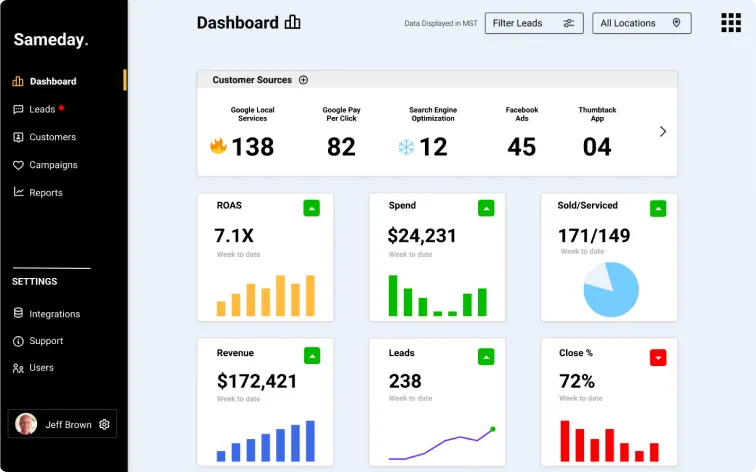
Every call an AI handles generates structured data. What service was requested, what the customer said, when they called, and whether they booked. That information flows directly into your CRM and scheduling system without manual entry. Voice AI with CRM integration means your team starts every interaction already knowing the customer's history, service needs, and last appointment.
What humans do better than any AI
Reading between the lines
A customer who says "I just need a tune-up" might actually be describing symptoms of a system that is about to fail. An experienced tech or CSR recognizes the subtext and probes further. AI can ask structured follow-up questions, but it cannot yet match the intuition of someone who has handled thousands of HVAC calls.
Building trust under pressure
When a customer is upset, scared about a potential repair bill, or frustrated by a previous bad experience, they need to feel heard by a real person. AI can de-escalate routine frustration, but deep emotional situations need a human who can respond with genuine empathy and adapt in real time.
Complex quoting and diagnosis
Multi-system replacements, commercial HVAC assessments, jobs that require site visits before pricing, these are not situations for automation. Your experienced sales staff and senior techs need to own these conversations from start to finish.
Relationship management
Long-term commercial clients and high-value residential customers want to know who they are dealing with. Account managers and senior CSRs build the kind of trust that keeps contracts renewed and referrals coming in. AI supports those relationships by keeping data accurate and follow-ups consistent, but it does not replace the relationship itself.
Where the handoff happens
The handoff between AI and humans is where most HVAC answering service setups either pay off or fall apart.
A well-designed system looks like this:
The key is that when AI transfers a call, the human receiving it already knows everything. No customer should have to repeat themselves. That single detail is what makes the handoff feel seamless rather than frustrating.
What this combination does for your bottom line
Running a human-only contact center at full coverage is expensive. Salary, benefits, training, turnover, and the structural cost of managing shift coverage add up fast. Reducing call centre costs for home service companies is one of the most direct financial benefits of adding AI to the mix.
Here is a rough comparison:
The financial case is straightforward. But the operational case matters just as much. When your human team is not spending half their day on routine first-call handling, they have capacity for the work that actually requires their skill, judgment, and experience.
Building the right setup for your HVAC business
A few principles that hold across business sizes:
Start with clear call routing rules
Define upfront which call types go to AI, which go straight to a human, and what triggers an escalation. The more specific your rules, the better the system performs.
Train your team on the handoff
When a call transfers from AI to a human, your staff should know how to pick up the context immediately and not start the conversation from scratch.
Use the data AI generates
Every AI-handled call is a source of information about your customers, your busiest hours, your most common service requests, and your conversion rates. Review it regularly.
Run the best HVAC answering service setup for your size
A solo operator and a 20-tech HVAC company need different configurations. An HVAC specialty answering service built for the trades will let you customize routing, scripts, and escalation paths to match your actual operation.
Combining AI and human support in HVAC
AI and human support are not competitors. In HVAC, they are the combination that lets you answer every call, handle every emergency, book every appointment, and still give your best customers the personal attention they expect.
The businesses that treat this as an either-or choice end up with a gap somewhere, either in coverage, in cost, or in quality. The ones that build both into their contact center close that gap completely.
See how Sameday's AI answering service for home services fits into your HVAC operation and book a demo to see it in action.


.svg)
.svg)