

Updated on 23rd of June 2026
Your phone just rang. You're on a roof, under a sink, or finishing a service call. When you are ready to get back to it, the caller is already booking with whoever answered first.
That's a consistent, compounding revenue leak. And for HVAC companies, plumbers, roofers, and other home service contractors, the phone remains the single most valuable sales channel you have.
According to Invoca's research, 27% of calls to home service businesses go unanswered. And another research shows that 85% of those callers will not try again. They call the next contractor on the list.
A virtual receptionist for home service businesses fixes this. But there are many solutions available and not all virtual receptionists are built the same. This guide breaks down your real options and what actually matters for businesses in the trades.
TLDR
- Home service businesses miss 27% of inbound calls on average, according to Invoca research
- Phone leads in home services convert at 46% on the call, the highest of any industry Invoca analyzed
- Three main options exist: live answering services, IVR systems, and AI receptionists
- Live answering services cost $300 to $800+ per month plus per-call fees; quality varies between agents
- An AI receptionist built for home services answers every call, books appointments automatically, and works 24/7 at flat-rate pricing
- The right solution connects directly to your scheduling software and CRM without manual follow-up
- After-hours calls are where you win or lose jobs your competitors are asleep through
How does a virtual receptionist help home service business?
A virtual receptionist handles incoming calls on your behalf without someone sitting in your office.
For home service companies, this means:
- Answering calls around the clock, including weekends and after-hours
- Collecting customer details and understanding the nature of the request
- Booking or rescheduling appointments directly in your scheduling system
- Triaging urgency and routing emergency calls to the right person immediately
- Answering common questions about services, pricing, and availability
The difference between a virtual receptionist and a standard answering service comes down to what happens after the call is answered. A standard answering service takes a message and stops there. A true virtual receptionist resolves the call, books the appointment, and updates your system. For home services, where the window to book a job closes fast, that distinction has a direct dollar value.
Phone leads from home services convert at 46% on the call, the highest of any industry Invoca has analyzed. Your phone line is your highest-converting sales channel.
Three types of virtual receptionists
Live answering services
Real agents, usually working from a remote call center, answer calls on your behalf. They take messages, provide basic information, and sometimes schedule appointments if given access to your calendar.
Live services work best for businesses with low call volume or calls that require genuine human judgment and emotional nuance. For home services contractors handling dozens of inbound calls daily, the limitations show up fast. Quality varies between agents, availability during peak times is inconsistent, and the per-minute or per-call billing model becomes expensive quickly during busy seasons. Most live services also do not integrate with your CRM or field service software, meaning someone still has to enter that data manually afterward.
IVR and automated phone systems
Interactive Voice Response, or IVR, is the press-1-for-this, press-2-for-that system. It routes calls through a menu and does nothing else. It does not book appointments, understand natural language, or resolve customer needs. For a homeowner calling with a burst pipe at 7 PM, it is a frustrating dead end.
IVR has its place in large enterprise call routing environments, but it is not a solution for home service businesses where every call is a potential booking.
AI receptionists built for home services
An AI phone answering for home services takes a natural conversation with your caller. It understands what the customer needs, checks your schedule, confirms the appointment, and sends a confirmation, all before the call ends. It handles multiple calls simultaneously, never puts anyone on hold, and works exactly the same way at 2 AM on a Sunday as it does at 10 AM on a Tuesday.
For home service businesses of any size, this is the only option that actually solves the problem of missed calls without the overhead of hiring or the unpredictability of per-minute billing.
How do these phone answering options compare?
One pricing reality worth understanding: live answering services look affordable at their base tier, but that rate rarely reflects what you actually pay. Overage fees, after-hours premiums, and per-call charges stack up fast during busy seasons. A plumbing company receiving 150 calls per month averaging three minutes each needs roughly 450 minutes of receptionist time. At most live service pricing tiers, that lands between $800 and $1,200 per month, and it scales upward any time call volume increases.
Learn more about the ROI of AI answering services for home services.
Does your trade affect which option works best?
Yes. Here is how different home service industries stack up:
- HVAC: High call volume, seasonal spikes, frequent emergencies. An AI receptionist handles after-hours calls without adding to your costs.
- Plumbing: Many calls are urgent. The best virtual receptionist for plumbing needs to triage urgency and route emergencies to the right person immediately.
- Roofing: Calls are often quote-driven. AI captures lead details and books estimates without back and forth.
- Pest control: Repeat customers and recurring appointments. Automation significantly cuts admin time.
- Solar: Longer sales cycles with more qualification needed. AI captures the lead and hands it off to your sales team with context already gathered.
- Commercial cleaning: Contract-based relationships with high call volumes. Automation handles the load without adding headcount. Inform yourself about the special AI receptionist setup for cleaning companies to be prepared.
Why home services demand more than basic call handling
A simple answering solution for home services may work for a salon or a dental office. Home services run at a different pace.
- Calls are urgent: A homeowner calling about a burst pipe at 6 AM is not comparing options. They need someone right now. Response speed is the whole game.
- You are competing on timing: Research published in Harvard Business Review found that the odds of qualifying a lead fall sharply after just five minutes. In home services, the first business to confirm a booking almost always gets the job.
- Your team is in the field: Technicians are on rooftops, under sinks, and in attics. They should not be stopping to field incoming calls.
- After-hours calls carry real revenue: An emergency HVAC call on a Saturday night or a pest situation over a holiday weekend is a high-value job. A live answering service at those hours gets expensive fast. An AI receptionist handles it at no additional cost.
What should a home service contractor look for in a virtual receptionist?
Voice AI with real scheduling integration
The system must connect directly to your calendar and your field service software. Taking a message for someone to follow up on later is just adding a manual step, not solving the problem. The appointment should be confirmed on the call.
Understanding of home service scenarios
Routine call volume is straightforward. The system also needs to distinguish between a drain clog and a sewage backup, identify an emergency air conditioning failure, and check your service area before booking. General-purpose AI tools often fall short here. Purpose-built solutions for the trades handle these distinctions reliably.
After-hours and weekend coverage
This is where a significant share of your revenue lives. The calls that come in at 9 PM on a Friday or 8 AM on a Saturday are often the highest-value jobs. Your answering system needs to handle them exactly as well as it handles Tuesday morning calls.
Smooth handoffs for complex situations
When a call genuinely needs a human, the transfer should carry the context of the conversation. The customer should not have to explain themselves again. A well-designed automated phone system collects the relevant details before transferring, so the technician or dispatcher picks up with context already in hand.
Predictable, flat-rate pricing
Per-call fees get painful fast during a busy season or after a strong marketing push. Understanding AI answering service pricing upfront helps you budget without surprises and know the right questions to ask any provider.
Before you commit to a system, going through a checklist for evaluating your phone answering service helps you compare options without missing anything important.
What does an AI receptionist look like in practice for a home service business?
Here is a straightforward example of what this looks like end-to-end:
- A customer calls at 9 PM on a Sunday about an HVAC issue
- The AI picks up immediately, no hold music, no voicemail prompt
- The customer explains the problem in plain language
- The AI confirms the service needed, checks availability, and offers open time slots
- The appointment is booked and confirmed before the call ends
- A service ticket is created in your field service software with all the customer's details
- A confirmation SMS is sent to the customer with arrival window and tech information
- Your technician shows up Monday morning with a fully documented job already in the system
Nothing falls through the cracks. No one has to manually enter data. No follow-up call is needed to confirm the booking.
Sameday customers report exactly this kind of workflow. Joshua Smith, COO of Arizona Roofing Systems, noted after implementing Sameday: "We have not been missing any calls like we were previously. We also use it for after hours which works out wonderfully." Konnor Buscho from Way Cool Plumbing & Air added that in just four months, Sameday managed over 4,000 calls for their business.
That is what a well-run virtual call center setup for home service companies looks like in practice. Not just routing a call, but completing the booking before the customer hangs up.
What does a virtual receptionist cost?
Over a full year, a live answering service with per-call billing can cost two to three times more than an AI solution, with fewer features to show for it. For a side-by-side look at specific tools, this breakdown of top AI phone answering systems for home services covers the leading options in detail.
How does an AI receptionist integrate with ServiceTitan and other field service software?
For contractors using ServiceTitan, the integration goes well beyond basic scheduling. An official partnership means the connection has full read and write access, not just a surface-level sync.
What that looks like in practice:
- New customer records are created automatically from call data
- Appointments are booked directly to the dispatch board
- Service tickets are generated with job descriptions, urgency notes, and customer history
- Technician availability is checked in real time before confirming a slot
- Existing customer records are matched so callers are recognized on return calls
Sameday is an official ServiceTitan Technology Partner. The same depth of integration is available for FieldRoutes, Service Fusion, Jobber, and Housecall Pro. For any software with an available API, a connection is achievable through direct integration or a Zapier workflow.
Read our comparison of Voice AI platforms with ServiceTitan integration for a full overview.
Sameday's results across home service industries
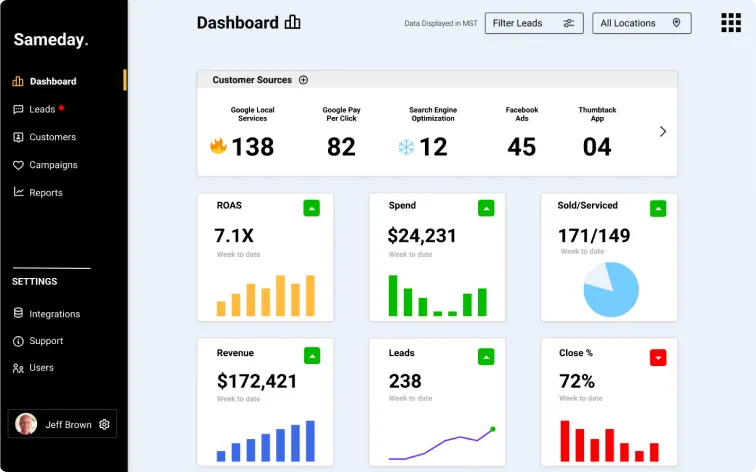
Sameday's AI receptionist for contractors has answered over 2 million calls in the trades. Across channels and customers, Sameday reports a 92% booking rate. That number reflects calls where the customer reached the system and an appointment was confirmed, not just calls that were answered.
Adam Cobb, Head of Customer Experience at Pipedreams, put it this way: "Our early results show AI booking rates equal to or better than some of our human CSRs."
Konnor Buscho from Way Cool Plumbing & Air saw the operational impact directly: four months in, Sameday had managed over 4,000 calls with meaningful improvements in customer retention and reduction in service issues.
Rob Greer, COO of Rove Pest Control, noted two consecutive weeks with zero missed Google Local Services calls after implementing Sameday.
Choosing the best virtual receptionist for home service businesses
The best virtual receptionist for a home service business is not the most premium-sounding one. It is the one that answers every call, books every appointment, and handles a Sunday night emergency just as reliably as a Tuesday afternoon inquiry.
Live answering services have their place, but they do not scale, they are expensive, and quality shifts from agent to agent. IVR systems route calls but do not resolve them. An AI receptionist built for home services does the full job, automatically and consistently, at a price that makes sense as you grow.
If you are ready to stop losing jobs to unanswered calls, see how Sameday's AI phone answering service for home services works for your business and book a free demo today.

.svg)
.svg)