
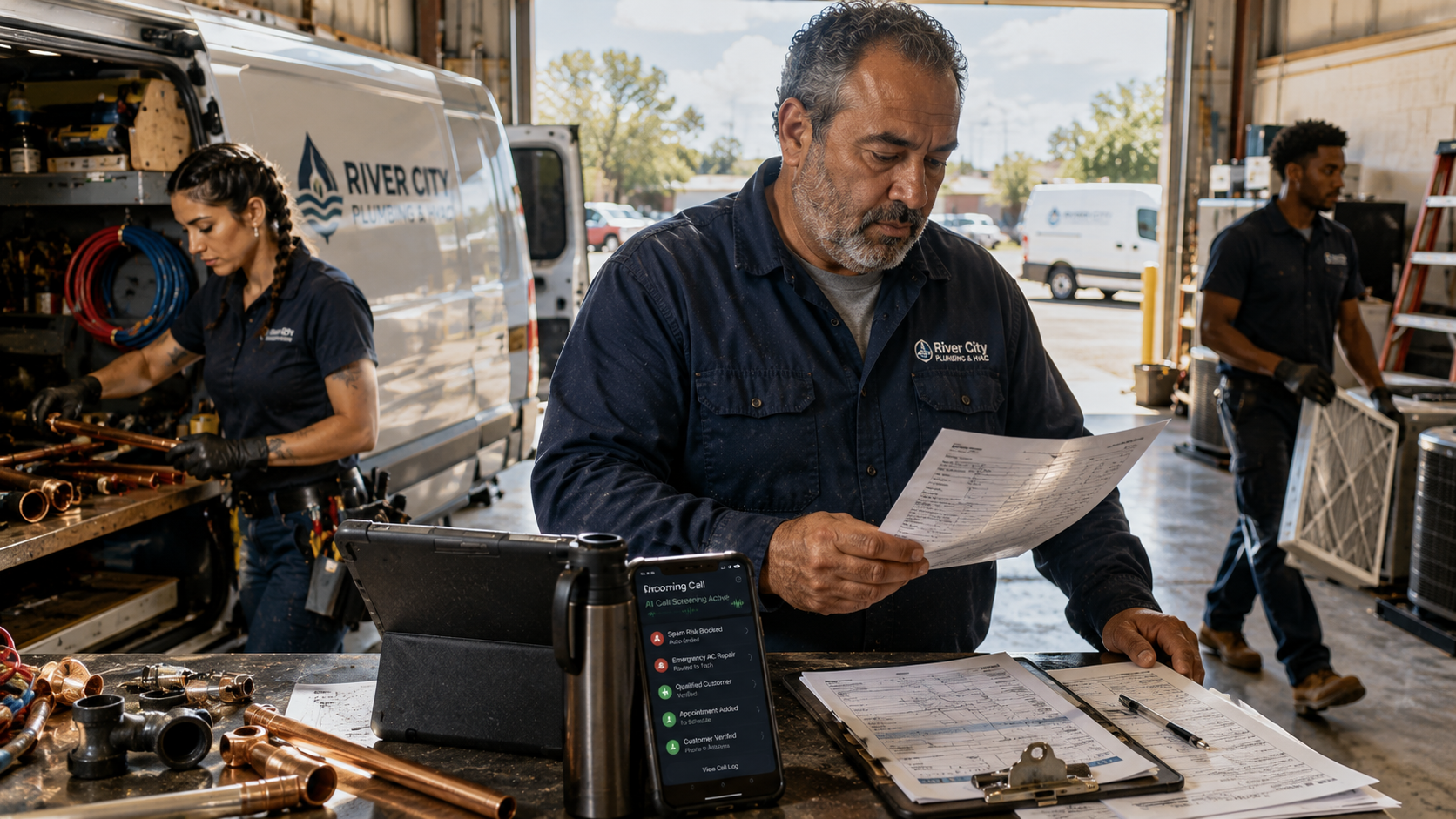
Every contractor phone line is a mix of signals and noise. Real customers with real jobs sit alongside spam calls, wrong numbers, vendor pitches, and time-wasters asking questions they could have Googled. Your team spends time on all of it, and the genuine leads sometimes fall through while the noise gets handled first.
AI call screening changes that. It filters the noise, qualifies the real calls, and routes everything to the right place automatically.
This article explains exactly how it works and what it means for a home service business in practice.
Why call screening matters for your business
Your phone line is not just a booking channel. It is also one of the biggest time drains in your operation if it is not managed well.
Research from Dialzara found that for small businesses, up to 90% of incoming calls can be spam or robocalls. Staff handling those calls manually are spending real time on interactions that produce zero revenue, while genuine customer calls wait or go unanswered.
At the same time, YouMail's 2025 Robocall Index reported that U.S. consumers received 52.5 billion robocalls in 2025 alone, with scam and telemarketing calls making up 57% of total robocall volume. That volume is reaching your business line too.
The result is a double problem: staff get pulled off real work to answer junk calls, and legitimate customers sometimes hit voicemail because the team is already tied up. AI call screening solves both sides of that at once.
What is AI call screening?
AI call screening is the process by which an automated phone system for home services answers every inbound call, identifies the nature of the call, qualifies legitimate leads, filters out junk, and routes everything appropriately, without a human involved in any of those steps.
It is not a phone menu. It does not ask callers to press 1 or press 2. It has a natural conversation with the caller, detects the intent of the call in real time, and decides what to do with it based on rules your business sets.
For a home service company, that means the AI can tell the difference between a homeowner with a leaking pipe and a robocaller trying to sell you business insurance. One gets qualified and booked. The other gets filtered out before it wastes anyone's time.
How does the screening process with AI work, step by step?
When a call comes in, the AI moves through a sequence that happens in seconds.
Step 1: Instant answer. The AI picks up immediately, every time. No ringing out, no hold music, no voicemail.
Step 2: Intent detection. Using natural language processing, the AI identifies what the caller wants. Is this a new service request? An existing customer needing to reschedule? A billing question? A vendor call? The AI reads the conversation in real time and assigns an intent category.
Step 3: Spam and junk filtering. Calls that match known spam patterns, robocall signatures, or irrelevant call types get identified and ended or logged automatically. According to NextPhone's analysis of 347,609 calls across over 2,000 businesses, AI screening filtered 26,320 spam calls automatically in a single year, representing hundreds of hours of saved staff time.
Step 4: Lead qualification. For genuine customer calls, the AI moves into qualification. It asks the questions your team would ask: job type, property address, urgency, preferred timing, whether they are an existing customer. The answers determine how to handle the call.
Step 5: Routing. Based on the qualification, the AI phone agent either books the job directly, transfers to a live team member, sends a follow-up text, or logs the call for review. Urgent calls, high-value leads, and complex situations get escalated to a human immediately. Routine bookings get handled end to end by the AI.
Step 6: CRM sync. Every qualified call creates or updates a record in your field service software automatically. The job type, address, contact details, and urgency level are all captured and written to your system in real time.
How a voice AI answering service works with CRM integration covers the full data flow in detail. The screening and the booking are part of the same continuous process.
What questions does the AI ask during screening?
The qualification questions vary by trade and job type. That is by design. A generic script that does not know the difference between an HVAC call and a roofing call will not qualify either one correctly.
A well-configured AI phone answering system for home services uses trade-specific logic. For HVAC calls, that typically means: what type of system, what is the issue, is the system running at all, and how urgent is it. For plumbing: where is the problem, is water actively running, and is this a repair or a replacement. For roofing: is this storm-related, is there active leakage, and is an insurance claim involved.
The answers do two things. They tell the AI how to prioritize the call, and they give your technician or dispatcher the context they need before they ever pick up the phone. By the time your team looks at the job in the system, the groundwork is already done.
How does AI screening handle emergency calls?
Emergency calls need to be identified fast and escalated immediately. That requires the AI call screening to detect urgency signals from what the caller says, not just from a formal menu selection.
If a homeowner calls at 11pm describing water coming through the ceiling, the AI picks up the urgency from the language of the call. It flags the job as an emergency, attempts to connect the caller to an on-call technician right away, and logs the full call details in your system.
How HVAC companies use AI phone answering to capture emergency calls covers this workflow in detail. The core point is that emergency screening is not about call menus. It is about the AI reading the context of the conversation and acting on it.
For businesses that need structured 24/7 emergency coverage, emergency answering service with 24/7 AI call coverage explains how to build that system properly, including how escalation rules are configured and how after-hours routing works in practice.
What happens to calls that do not qualify?
Not every call that comes in is a booking opportunity. Some callers are outside your service area. Some want a service you do not offer. Some are existing customers with questions that do not require a technician.
AI call screening handles all of those without pulling anyone on your team into the loop. Calls from outside your service area get a polite, professional response and are logged. Existing customers with billing or scheduling questions get handled directly by the AI if the question falls within its configured scope, or transferred to the right team member if it does not. Vendor calls and wrong numbers are filtered without any human interaction.
This is what how AI customer service influences booking rates for home service companies calls the handoff problem: every time a call gets passed to the wrong person or handled by the wrong process, there is a chance it goes cold. Good screening removes those handoffs entirely for the calls that do not need them.
How does AI screening compare to a live receptionist or call center?
A live receptionist handles one call at a time, works set hours, and brings variable quality depending on who is on shift. A shared call center adds agents but loses trade-specific context. Neither scales automatically when call volume spikes during storm season or peak summer demand.
An AI virtual receptionist handles unlimited concurrent calls. Every caller gets the same quality of screening regardless of time of day, call volume, or how busy your office is. And it does not cost what a full-time staff member costs.
The best virtual receptionist for home remodeling covers this comparison in the context of a high-ticket trade where every qualified call is worth thousands of dollars. The same math applies across HVAC, plumbing, pest control, and any other trade where job values are meaningful.
Upgrade your business with a virtual receptionist that screens, qualifies, and books
The real cost of poor call screening is not just wasted staff time. It is qualified leads getting lost in the noise, urgent jobs going unrouted, and your team burning capacity on calls that should have been filtered before they ever picked up.
AI call screening fixes the front of that process cleanly. Every call gets answered. Junk gets filtered. Genuine leads get qualified with the right questions, routed to the right place, and booked directly into your system, all before a human has to touch it.
Book a demo with Sameday to see how an AI answering service handles your inbound calls, filters the noise, and books qualified jobs automatically from day one.

.svg)
.svg)