
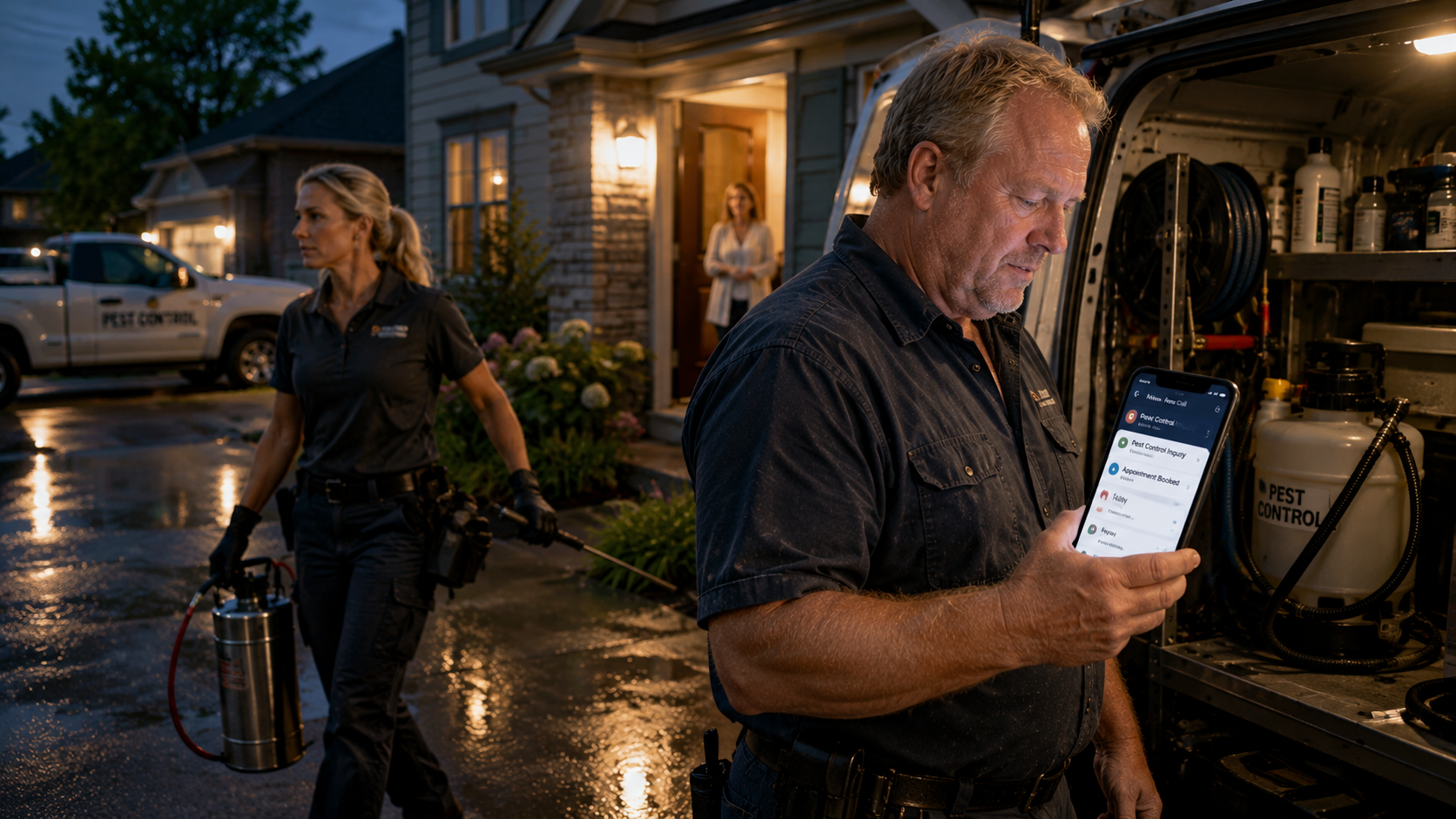
Most home service businesses are not short on leads. They are short on conversions. Homeowners call, no one picks up, or the callback comes 40 minutes too late. The lead goes cold. The job goes to whoever answered first.
That is a customer service problem. But not anymore. In 2026, AI is solving it in ways that directly move booking rates.
This article breaks down exactly how AI customer service affects booking rates in home services, what the data shows, and what a well-configured system actually looks like in practice.
Why booking rate is the number that actually matters
Booking rate is the percentage of qualified inbound calls that turn into scheduled jobs. It is the clearest signal of how well your phone handling is working.
Most home service companies do not track it closely. They track leads and closed jobs, but not what happens in between. That gap hides the real problem.
According to ServiceTitan's 2025 Home Services Benchmark Report, covering over 100,000 businesses, the average home service company converts just 28% of inbound leads into booked appointments, at an average response time of 42 minutes. Companies that respond within two minutes convert 62% of leads. That is more than double, from the same lead volume, with zero additional marketing spend.
The gap between 28% and 62% is not a marketing problem. It is a customer service problem. And AI closes it.
How does response time affect booking rates?
Speed is the most direct lever on booking rate in home services.
Research compiled by Estatehub for 2026 shows that 78% of customers hire the first contractor who responds with a clear next step. Responding within 60 seconds can improve conversions by up to 391%. Waiting five minutes drops your qualification chances by 80%.
The average contractor, meanwhile, takes 42 minutes to respond to a new inquiry. By that point, most homeowners have already booked with someone else.
An AI receptionist for contractors picks up in seconds. Not minutes. Every call gets answered at the same speed, at 2pm on a Wednesday or 9pm after a storm. That consistency is what lifts booking rate at scale.
How does AI customer service work for phone calls?
The term "AI customer service" covers a wide range of tools. In the context of home services, what matters is what happens on the phone.
A well-built home services answering service powered by AI does the following during an inbound call:
- Answers within one ring, every time
- Identifies whether the caller is new or an existing customer
- Asks trade-specific qualification questions
- Checks technician availability in real time
- Books the appointment and confirms it with the caller
- Creates or updates the job record in your CRM automatically
No message to review. No callback to schedule. No manual data entry. The job is on the board before the call ends.
How a voice AI answering service works with CRM integration covers the full technical workflow. The short version is that the AI writes directly to your field service software in real time, which means your team starts the next morning with jobs already scheduled.
How does AI customer service influence booking rates specifically?
There are four direct mechanisms.
1. It answers calls that would otherwise go to voicemail.
Invoca's research found that 27% of inbound calls to home service businesses go unanswered. Of the callers who do reach voicemail, 85% hang up without leaving a message and do not call back. Every missed call is a lost job. An AI that answers 100% of calls removes that leak entirely.
2. It responds at the speed customers expect.
With 82% of consumers now expecting an immediate response to a service inquiry, according to HubSpot's 2024 State of Marketing Report, a 42-minute callback is not just slow. It is a disqualifier. The AI responds in seconds, which is what keeps the homeowner on the line instead of moving to the next result.
3. It qualifies and books without handoff delay.
Every handoff in a sales process is a place where leads go cold. The traditional flow is: call comes in, CSR takes a message, CSR or dispatcher follows up, availability is checked, callback is made, booking happens. That is five steps with four potential points of failure.
An automated phone system for home services compresses that entire sequence into a single two-minute call. The homeowner calls, gets qualified, and books. Done.
4. It captures after-hours and weekend calls.
Hatch's 2025 data shows that home service companies without after-hours automation lose 34% of their leads to next-day response delays. Those are real jobs, often high-urgency calls from homeowners who needed someone immediately and called whoever picked up. An AI running 24/7 captures those calls and books them overnight.
What booking rates can AI-handled calls achieve?
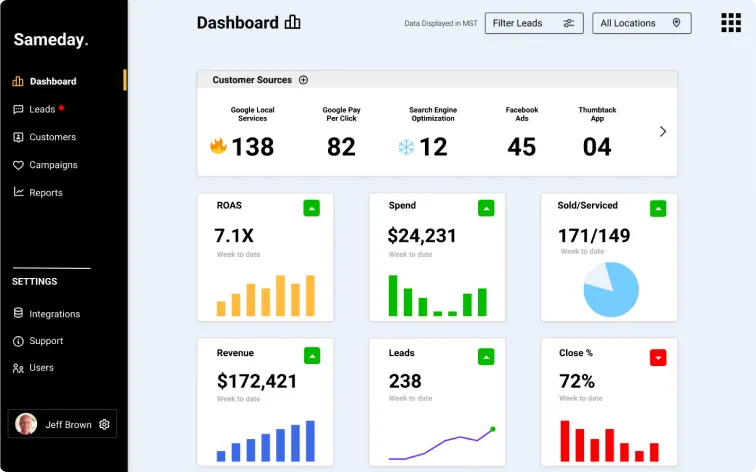
Sameday publishes booking rate data from customers across the US. Across multiple locations in California, AI-handled calls produce booking rates between 87% and 90%. For context, the industry average for manually handled calls sits around 28% to 46% depending on response time and trade type.
How AI answering services increase contractor booking rates breaks down the specific workflows that drive those numbers. The pattern is consistent: faster response plus consistent qualification plus real-time booking equals a materially higher percentage of calls turning into jobs.
Does AI customer service work differently across trades?
The mechanism is the same. The configuration is different.
An HVAC call during a summer heat wave needs the AI to identify urgency fast, check same-day availability, and prioritize the booking ahead of routine maintenance calls. A plumbing call about an active leak needs immediate triage questions. A roofing call after a storm needs to determine whether it is insurance-related and route accordingly.
How AI answering services help solar businesses capture leads they used to miss illustrates how the same AI infrastructure adapts to a completely different trade with different qualification logic and longer sales cycles. The underlying booking rate improvement is consistent across trades because the root cause, slow response and missed calls, is consistent across trades.
What does the ROI look like?
For a business generating 80 inbound leads per month at a $1,400 average job value, the gap between a 28% booking rate and a 62% booking rate is $381,000 in annual revenue, from the exact same marketing spend. That math comes directly from ServiceTitan's 2025 benchmark analysis.
The real ROI of AI answering services for home service businesses walks through that calculation in detail. The short version: improving conversion rate through response speed delivers a higher return than almost any other investment available to a home service operator, because it multiplies the value of marketing you are already paying for.
Companies also see a return of $3.50 for every $1 invested in AI customer service, according to data compiled by Fullview from leading research organizations. For home service businesses with strong lead volume, that math compounds quickly.
What to look for in an AI customer service system for home services
Not every AI phone system is built for the trades. Before evaluating options, know what you actually need.
Real-time CRM integration. The AI must write job data directly to your field service software. A system that emails you a summary to enter manually has not removed the bottleneck.
Trade-specific qualification logic. The AI needs to ask the questions your best CSR would ask, tailored to each job type. Generic scripts produce generic results.
24/7 coverage with no call limits. Peak season and after-hours coverage are two of the highest-value use cases. Make sure the system handles both without restrictions on concurrent calls.
Measurable booking rate data. Any provider worth working with can show you booking rate data from existing customers. That number tells you more than any feature list.
Warm transfer capability. The AI should know when to hand off to a human. Complex situations, upset callers, and high-value sales conversations all benefit from a live team member. The system should route those calls cleanly and quickly.
A virtual receptionist that runs your phone line like your best CSR
Your best CSR answers fast, asks the right questions, and closes the booking before the homeowner has a chance to call a competitor. They do it every time, with every caller, whether it is the first call of the day or the last.
An AI customer service system built for home services does the same thing, at any hour, on any volume of calls, without a sick day or a slow Monday.
The data is clear. Booking rate is a function of speed, consistency, and availability. AI delivers all three. The businesses using it are not just answering more calls. They are converting more of what they have already paid to generate.
Book a demo with Sameday to see how the AI handles your calls, connects to your field service software, and lifts your booking rate from day one.

.svg)
.svg)