

You track your marketing spend carefully. You know exactly how much each lead costs. Google Ads, door hangers, truck wraps, referral programs, you can tell which channels work and which don't.
But here's the number most contractors never calculate: how many leads that called you never turned into booked jobs.
Not because they chose a competitor. Not because your price was too high. But because the call experience itself killed the conversion before it ever had a chance.
That's the booking rate gap. The space between "phone rings" and "job scheduled." For most home service contractors, 40-60% of inbound calls never convert into appointments.
An AI answering service closes that gap by handling every call instantly, qualifying leads automatically, and booking appointments without the friction that makes customers hang up. Contractors who implement it correctly see booking rates jump from 45-50% to 75-85%. That's a 30-40% improvement, and it happens fast.
TLDR
- Most contractors convert 45-50% of inbound calls to booked appointments; AI answering pushes that to 75-85%.
- Speed matters more than most contractors realize, 78% of customers book with the first company that responds.
- AI eliminates the three biggest booking killers: missed calls, inconsistent qualification, and slow follow-up.
- Proper implementation requires clear routing rules, accurate pricing scripts, and integration with your scheduling system.
- The booking rate improvement compounds, more jobs booked per lead means lower customer acquisition cost and faster growth.
Why booking rates stay low without AI
There are three points where inbound calls die before they turn into jobs.
The call never gets answered
You're on a job site. Your office person stepped away. Your phone rings four times and goes to voicemail. According to research, 80% of calls that go to voicemail are never returned. They just call the next contractor on their list.
Even if you call them back within an hour, you're already the second choice. The first company that answered got the booking.
The caller gets frustrated during the qualification process
Your team answers, but they're rushed. They don't ask the right questions. They tell the customer, "someone will call you back with pricing," which adds another delay. Or they ask too many questions in a disorganized way, and the caller feels like they're being interrogated.
Even when your team follows the best customer service etiquette for home service professionals, the experience can still fall apart in the moment. The customer gets impatient, the conversation loses direction, and before you know it, they hang up or move on to the next company.
The scheduling process creates unnecessary friction
The customer wants Tuesday afternoon. Your scheduler says they'll check with the team and call back. Two hours pass. The customer booked with a competitor who offered them a confirmed time slot on the first call.
Every additional step between "I need service" and "you're scheduled for Tuesday at 2 PM" is a chance for the deal to fall apart.
What AI does differently that raises booking rates?
An AI phone answering for contractors fixes all three problems with speed, consistency, and immediate confirmation.
Instant answer, every time
AI picks up in under two seconds, whether it's your first call of the day or your fiftieth. No hold times. No "we're experiencing higher than normal call volume" messages. Just an immediate, professional greeting.
This matters more than most contractors think. A study by InsideSales.com found that leads contacted within 5 minutes are 21 times more likely to convert than those contacted after 30 minutes. In home services, where customers are often calling with urgent needs, such as a broken AC, a leaking pipe, or an electrical issue, that window is even tighter.
Structured qualification that feels conversational
AI asks the same questions every time, in the same order, without skipping steps or getting distracted. But it doesn't sound robotic. Voice AI for home services is trained to handle conversations naturally:
AI: "What type of service do you need today?"
Caller: "My water heater is making a weird noise."
AI: "Got it. Is it a gas or electric water heater?"
Caller: "Gas, I think. It's in the garage."
AI: "Perfect. And how old is the unit, roughly?"
The caller doesn't feel like they're filling out a form. They're having a conversation. But on the backend, AI is capturing structured data that goes straight into your CRM.
Immediate booking with real-time availability
Instead of "let me check and call you back," AI looks at your actual calendar and books the appointment on the spot.
AI: "I can get a technician out to you tomorrow at 2 PM, or Thursday at 9 AM. Which works better for you?"
Caller: "Tomorrow at 2 works."
AI: "Great, you're scheduled for tomorrow, Tuesday the 15th at 2 PM. I'm sending a confirmation text to your phone now. Anything else I can help with?"
The job is booked, the calendar is updated, and the customer has confirmation, all before they hang up. No follow-up calls needed. No risk of them changing their mind while waiting for a callback.
The booking rate improvement in real numbers
Here's what the shift looks like for a typical contractor handling 200 calls per month:
The contractors, seeing these results, are in typical situations. They run standard operations with similar team sizes, similar call volumes, and the usual day-to-day pressure of handling customer inquiries; one to five trucks, a mix of residential and light commercial, competing in normal markets. The difference is that they're capturing calls they used to miss and converting calls they used to fumble.
Seeing how electrical contractors use AI phone answering to capture every call shows similar patterns across different trades. The operational challenges are the same, and so are the results.
Where the booking rate improvement comes from
AI plays a practical role in the booking process. It handles the operational gaps that often get in the way, so interested customers can move forward and schedule a job without friction.
Higher answer rate
If you're currently answering 60-70% of calls, moving to 100% immediately adds 30-40% more opportunities. Not all of those will convert, but even if half do, you've just increased your booking volume significantly.
Consistent qualification
Human teams have good days and bad days. They forget to ask about service addresses. They skip upsell questions when they're busy. AI asks every question, every time. And even in different languages! For example: When you have a lot of Spanish-speaking clients, you can easily get a bilingual Enlish and Spanish-speaking AI-receptionist. That consistency means fewer misqualified leads and fewer jobs that get booked and then cancelled because key details were missed.
Faster speed to booking
The time between "customer calls" and "appointment confirmed" drops from hours or days to minutes. That speed matters. Customers calling about home service needs are usually in problem-solving mode. The first contractor who gives them a confirmed solution wins.
Better after-hours and overflow capture
Calls that come in at 7 PM on a Saturday used to go to voicemail. Now they get answered, qualified, and booked. Emergency jobs often carry premium pricing, so capturing those calls has an outsized impact on revenue.
Understanding the tactics behind maximizing lead conversion by combining voice AI and human support shows that booking rate improvement is about removing the capacity constraints that prevent them from converting every opportunity.
What setup gets you to 30-40% improvement
Not every AI implementation delivers these results. The contractors who hit a 30-40% booking rate improvement follow a specific setup pattern.
Clear routing rules
Define exactly which calls AI handles end-to-end and which get transferred to humans:
- Standard service calls (routine maintenance, common repairs) → AI books start to finish.
- Complex diagnostics or quotes → AI qualifies and routes to senior staff.
- Existing customer account questions → AI pulls history and resolves or transfers.
- Complaints or service failures → Immediate transfer to manager.
The tighter your routing rules, the fewer awkward handoffs you create.
Accurate pricing and availability data
An AI answering service can only quote accurately if you give it clear rules. If your pricing varies by job complexity, distance, or time of day, build those variables into the system. If certain time slots fill up fast, connect AI to your real scheduling system so it sees actual availability.
Guesswork creates problems. A customer who books based on an AI quote that turns out to be wrong is an angry customer, not a booked job.
Integration with your scheduling and CRM tools
AI that books appointments directly into your calendar prevents double-bookings and eliminates the manual step of transferring information. AI that logs call details into your CRM means your team has full context when they show up on-site.
Disconnected systems create extra work. Connected systems create compound value.
Training your team on the handoff
When AI transfers a call to a human, that person should pick up knowing exactly what was already discussed. No "let me ask you a few questions" when the customer just answered those questions with AI. Smooth handoffs feel like one continuous conversation with your company, not a game of telephone.
Beyond inbound: How AI extends booking improvements to outbound
Most contractors think of AI answering as a defensive tool; it catches calls you might otherwise miss. But it also works offensively.
AI cold calling can help home service businesses generate outbound leads by reaching out to past customers for seasonal maintenance, following up on quotes that didn't close, and reactivating dormant accounts. The same voice AI that handles inbound calls can also make outbound calls to turn your database into recurring revenue.
That's where the booking rate improvement compounds. You convert more incoming leads and create new opportunities from your existing customer base.
The financial impact of a 30-40% booking rate increase
Booking rate improvement hits your bottom line in three ways.
Lower customer acquisition cost: If you're getting 80 bookings from 200 calls instead of 50 bookings, your cost per acquisition drops by nearly half. You're paying the same for leads but converting far more of them.
Faster growth without more marketing spend: Most contractors trying to grow throw more money at ads. But if you're only converting 40% of your current leads, you're wasting 60% of your marketing budget. Fix the conversion problem first, then scale marketing.
Higher revenue per employee: Your field team can only run so many jobs per week. When booking rates improve, you're filling their schedules with better-qualified jobs instead of scrambling to replace cancellations and no-shows.
Looking at the real ROI of AI answering services shows that booking rate improvement is often the single largest driver of return, more than cost savings or efficiency gains.
Getting to 30-40% improvement in your operation
The contractors who hit these numbers don't treat AI answering as a plug-and-play solution. They set it up intentionally, monitor the metrics that matter, and adjust based on what the data shows.
Start by measuring your current booking rate. How many calls do you receive? How many get answered? How many turn into scheduled appointments? Those baseline numbers tell you where the gaps are.
Then implement AI answering with clear goals: answer 100% of calls, qualify every lead consistently, and book appointments without delays. Track the same metrics weekly for the first month. If booking rates aren't improving, the problem is usually in the setup: unclear routing, incomplete pricing data, or poor integration with your scheduling tools.
The 30-40% improvement is real, but it's not automatic. It comes from removing the specific operational barriers that exist in your business.
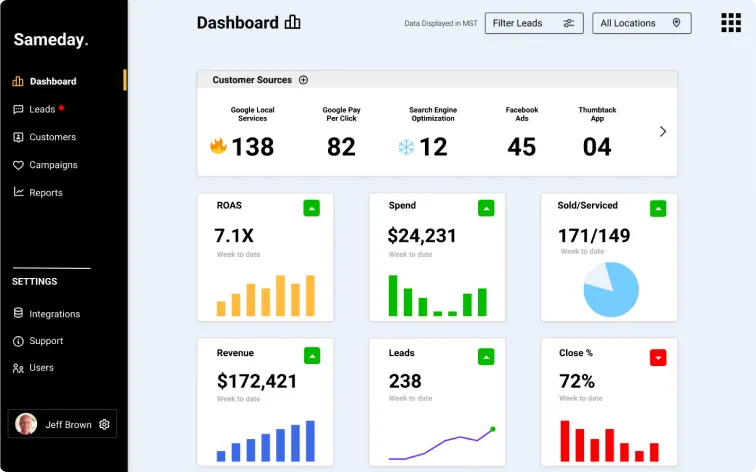
See how Sameday's AI booking system fits into your contractor operation and book a demo to see the booking process in action.


.svg)
.svg)