

You ran a Facebook ad campaign. Spent $3,000. Got 47 clicks. Generated 12 phone inquiries.
Your team answered three of them.
The rest went to voicemail. Four people left messages. You called them back the next day. Two had already booked with a competitor. One didn't answer. One said they'd "think about it."
That's $2,250 in ad spend that produced exactly zero installations.
This is the solar lead problem nobody talks about. Leads are coming in. The issue is that most solar teams are still operating as if it were two years ago, while demand has moved ahead. When inquiry spikes hit, whether from paid ads, referral surges, or seasonal demand, the same pattern shows up. Calls start to queue, wait times stretch, and prospects move on to whoever picks up first.
An AI answering service for home services fixes that gap without adding headcount.
TLDR
- 78% of customers choose the first business that responds to their inquiry, making speed the primary conversion factor in solar sales.
- AI phone answering handles inquiry surges, after-hours calls, and routine qualification without adding staff.
- Solar companies using voice AI for home services report 30-40% higher lead capture rates during peak campaign periods.
- The best systems route qualified leads to sales reps with full context, so no customer repeats themselves.
- AI keeps your sales team focused by making sure every lead actually reaches them.
Why solar lead management is harder than most home services
Solar installations are high-ticket purchases with long sales cycles. A homeowner considering a $25,000 system isn't making an impulse decision. They're comparing multiple quotes, researching incentives, and trying to figure out if their roof even qualifies.
But here's the thing: even though the decision takes weeks, the initial response window is measured in minutes.
According to research, leads contacted within five minutes are 21 times more likely to convert than those contacted after 30 minutes. In solar, where customers are simultaneously reaching out to three or four installers, that window is even tighter. The first company that answers and sounds competent usually gets the site visit. The rest are fighting for scraps.
At the same time, solar businesses face operational realities that make fast response difficult:
- Sales reps are on-site doing consultations or installations.
- Office staff is managing permits, utility interconnections, and project timelines.
- Peak inquiry times (evenings and weekends) are when nobody's in the office.
- Lead volume fluctuates wildly based on campaigns, weather, and incentive deadlines.
When a prospect calls at 7 PM on a Thursday because they just saw your ad, that's a qualified lead with high intent. If they hit voicemail, they're calling your competitor next. You just paid to generate a lead for someone else.
What AI phone answering does that a voicemail cannot
1. Answers every call in under two seconds
Voice AI call handling for solar companies picks up instantly, every time. No hold music. No "your call is important to us" loops. No voicemail boxes that fill up and stop accepting messages.
Homeowners calling about solar are comparison shopping in real time. The difference between a two-second answer and a 30-second wait is often the difference between booking a consultation and losing the lead entirely.
2. Qualifies leads before they reach your sales team
Not every inquiry is worth a sales rep's time. Renters, people with shaded roofs, homeowners outside your service area, these calls still need to be handled professionally, but they don't need to pull your closer off a hot lead.
AI phone answering handles the initial qualification questions:
- Do you own your home?
- What's your average monthly electric bill?
- Is your roof getting at least four hours of direct sunlight daily?
- What's your service address?
Qualified leads get routed to sales with all the context already captured. Unqualified leads get a polite explanation and a referral if appropriate. Your team only talks to people who are actually in-market.
Understanding how to set up an AI phone receptionist for home services with proper qualification flows is what separates systems that save time from systems that just add noise.
3. Captures leads during off-hours and weekends
Most solar inquiries happen outside of business hours. Homeowners research at night. They see your truck in a neighborhood on Saturday and look you up. They watch a YouTube video about tax credits on Sunday morning and start calling installers.
A home services answering service that runs 24/7 means those calls get answered, qualified, and routed. Your sales team starts Monday morning with a queue of warm leads instead of a list of missed calls to chase down.
4. Handles inquiry surges without breaking
You launched a radio spot. Your Google Ads budget doubled. A happy customer posted about their install on the neighborhood Facebook group. Suddenly, you're getting 40 calls in a day instead of your usual 12.
A human receptionist can handle one call at a time. AI scales instantly. Whether it's 5 calls or 50, everyone gets answered with the same speed and quality.
What your sales team still needs to do
AI handles the first touch, but solar sales require expertise and trust-building that only humans can provide.
1. Running consultations and site assessments
Roof pitch, shading analysis, panel placement, inverter selection- these conversations need someone who knows solar inside and out. AI captures the lead and books the appointment. Your sales rep closes the deal.
2. Handling complex pricing and financing questions
Every solar quote is custom. Panel count, system size, financing options, federal and state incentives, and utility rebates, there are too many variables for automation. Your experienced sales team owns this part of the process from start to finish.
3. Building long-term client relationships
Solar customers are some of the best referral sources in home services. A homeowner who had a great installation experience will send you neighbors, friends, and family for years. That relationship starts with the sales process and continues through installation and beyond. AI sets up the relationship. Your team builds it.
4. Managing commercial and multi-property projects
Large commercial installs, HOA solar programs, multi-family projects—these need account management and technical depth that goes way beyond what any automated system can handle. These leads should route directly to your senior sales staff.
How the handoff between AI and humans works
The weak point in most AI answering setups is the transition. A prospect talks to AI, gets transferred to a human, and has to repeat everything they just said. That's frustrating enough to lose deals.
A properly configured system using automated call distribution looks like this:
When a call transfers, your rep should see the prospect's name, address, electric bill estimate, qualification answers, and what they already discussed with the AI. No starting over. No awkward "let me ask you a few questions" when the customer already answered them.
That continuity is what makes the experience feel seamless instead of robotic. Prospects see it as one conversation with your company, not a handoff between systems.
What this means for your solar business economics
Running a dedicated receptionist costs $35,000 to $45,000 per year in salary and benefits. Adding a second person for after-hours coverage doubles that. For a solar installer doing 10-15 installations per month, that's a high fixed cost.
An AI answering service runs at a flat monthly rate (typically $300-$800 depending on call volume) with no overtime, no benefits, and no training costs. More importantly, it scales with your marketing spend. When you run a campaign and call volume triples, the system handles it without adding cost or staff.
Here's the clearer financial comparison:
The ROI case is simple. If AI answering helps you capture even two or three additional installations per month that you would have otherwise missed, it pays for itself many times over.
Cost savings are part of it. The bigger gain is capacity.. When your sales team isn't spending half their day answering unqualified inquiries and booking appointments, they're doing what they're actually good at: running consultations, closing deals, and building client relationships.
Exploring the top AI phone answering systems for home services shows how solar companies are using this shift to grow faster without adding proportional overhead.
Setting up AI answering for solar lead capture
A few practical steps:
Define your qualification criteria upfront
What questions need to be asked before a lead reaches sales? Homeownership, service area, roof condition, and budget range build these into the AI script so every lead that gets routed is actually worth pursuing.
Set clear routing rules
Residential installs under 10kW go to your junior sales rep. Commercial projects go straight to your senior closer. Urgent after-hours leads trigger a text alert. The more specific your routing, the better the system performs.
Train your sales team on the handoff
When AI transfers a call, your rep should pick up with "Hi, I see you're interested in a solar consultation for your home on Maple Street", not "Thanks for calling, how can I help you?" Continuity matters.
Use the data AI generates
Every call produces structured information: inquiry source, qualification status, conversion outcome. Review it monthly to see which marketing channels are driving qualified leads and which are generating noise.
Combining AI and human expertise in solar sales
The solar companies growing fastest right now are not choosing between AI and human sales teams. They are maximizing lead conversion by combining AI and human support to make sure every lead gets answered, every qualified prospect gets routed, and every sales rep spends their time doing what humans do best: building trust and closing deals.
The ones still relying on voicemail and callbacks are losing deals to whoever answers first. The ones trying to staff up for every inquiry surge are burning cash on overhead that doesn't scale.
Your solar sales process stays the same. AI makes sure it kicks off for every lead.
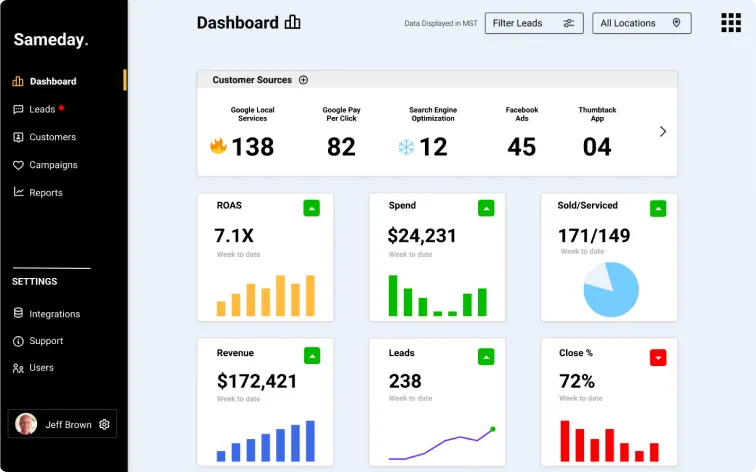
See how Sameday's AI answering service fits into your solar operation and book a demo to see it in action.


.svg)
.svg)