
Across industries it's common to use Voice AI for customer service these days.
AI handles the call. Something shifts. The customer is frustrated, the job is complex, or the situation needs a judgment call. The AI transfers to a human. But what happens next determines whether the customer stays on the line or hangs up.
That moment, the handoff from AI to a live team member, is where a lot of home service businesses quietly lose customers they thought they had. The AI did its job. But the transfer wasn't smooth, the human had no context, and the customer had to repeat everything from the start.
This article explains how to build a handoff protocol that makes that transition invisible to the customer and useful to your team.
Why the handoff matters as much as the AI itself
Most home service operators focus on whether the AI can answer calls and book jobs. That part is well-documented. What gets less attention is what happens when the AI cannot finish the job alone.
According to Freshworks' 2026 research on AI customer service, 68% of consumers prefer to speak with a human agent, and 63% say they would take their business elsewhere if human support was not available. That number should matter to every HVAC company, plumbing contractor, or pest control operator using an AI phone system. Customers will accept AI for routine calls. They will not accept it for calls that need empathy, judgment, or real-time problem solving.
The AI is not the product. The customer experience is the product. And the handoff is a critical part of that experience.
When should the AI hand off to a human?
Not every call needs a human. The goal is to route the right calls to the right place, not to involve your team in every interaction.
These are the situations that consistently require a live transfer in home services:
- Upset or emotional callers: A homeowner with no heat in January, a burst pipe causing active water damage, or a customer who had a bad experience on a previous visit. Those calls need a human voice and a real response, fast.
- Complex multi-part requests: A caller who wants to discuss an existing job, ask about a membership upgrade, and reschedule a future appointment all in the same call. The home services AI agent can handle each of those individually, but the combination may require human judgment about priorities.
- High-value sales conversations: A commercial contract inquiry, a large installation quote, or a customer who is ready to upgrade to a premium service plan. These are conversations worth the time of a skilled salesperson or senior CSR.
- Situations outside the AI's configured scope: If a caller's request does not fit any of the job types or workflows the AI is set up to handle, it should transfer cleanly rather than attempt a response that may be inaccurate or confusing.
Explicit requests for a human. If a caller asks to speak with someone, the AI should comply immediately. Attempting to re-engage them with more automated responses after that request is a fast way to lose the call.
What makes an AI to human handoff seamless?
The difference between a good handoff and a bad one is context. When the human picks up, do they know who they are talking to, why the call was transferred, and what has already been discussed?
Research from CCW Digital's 2024 Market Study found that 73% of contact center leaders say agents waste too much time looking up information mid-call, and 73% cite inefficient authentication as a recurring problem. Both of those issues trace back to the same cause: the handoff did not carry the context forward.
A well-designed handoff passes five things to the human agent before they say hello:
- Caller identity. Name, phone number, and whether they are a new or existing customer.
- Call reason. What the caller said they needed, in a brief summary.
- What the AI already collected. Address, job type, urgency level, any scheduling preferences already discussed.
- Escalation reason. Why the call was transferred, such as caller requested a human, situation flagged as urgent, or request outside AI scope.
- Sentiment signal. Whether the caller seemed calm, frustrated, or upset, based on tone and language during the AI portion of the call.
With that package, the human agent opens the conversation mid-stream rather than from zero. The customer does not repeat themselves. The agent sounds informed and in control.
How does this warm transfer work in a home services context?
In practice, the handoff for a home service company looks like this:
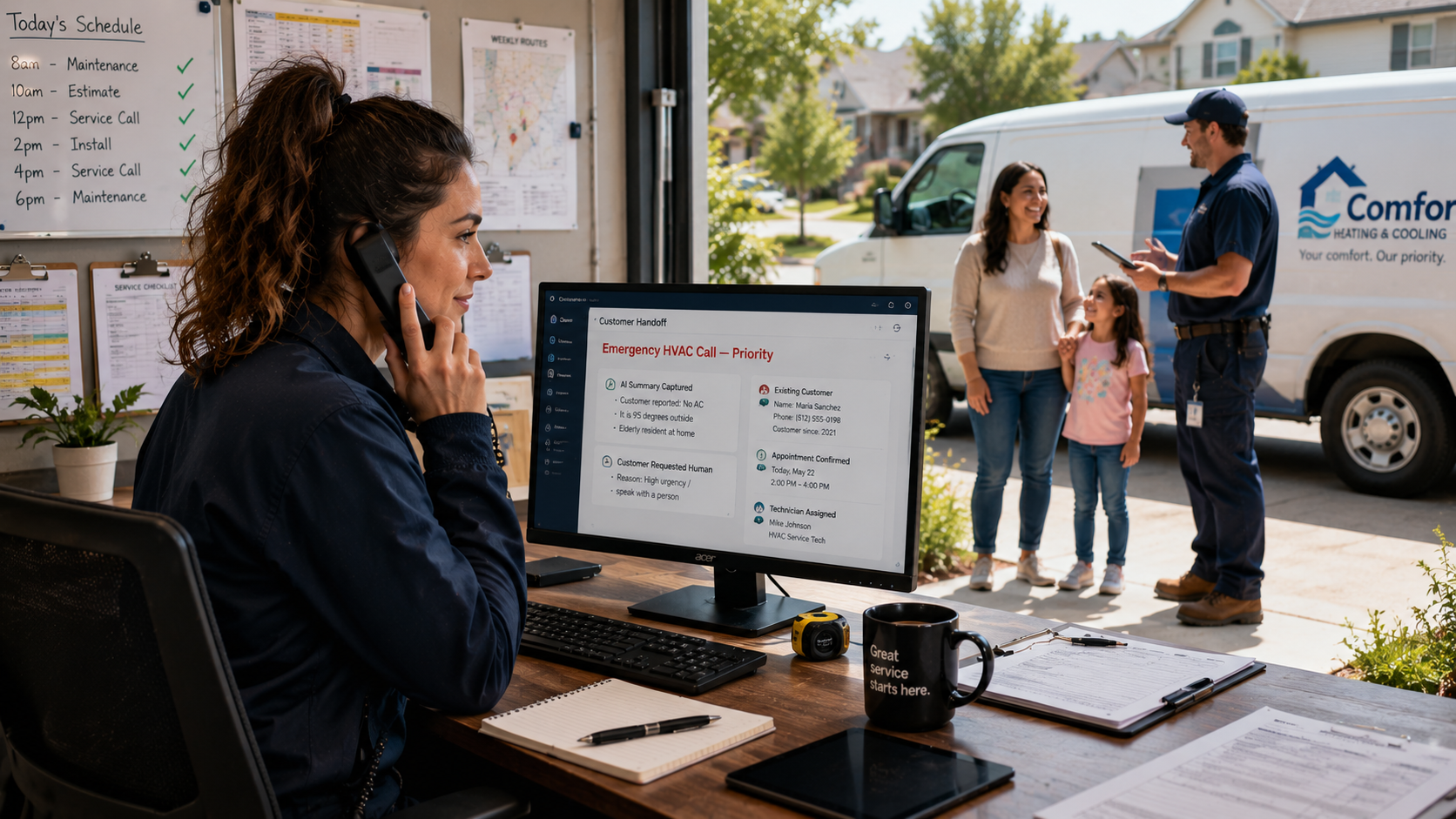
A homeowner calls about an HVAC system that stopped working. The AI receptionist answers immediately, identifies the customer, asks about the system type and what is happening. The homeowner mentions it is 95 degrees outside and they have an elderly parent at home. The AI detects the urgency, flags it as an emergency, and transfers the call to your on-call dispatcher with a summary: existing customer, no AC, extreme heat, vulnerable household member, treat as priority.
The dispatcher picks up and says: "Hi, I can see you have got an emergency situation there. We are going to get someone to you today." That is a completely different experience than transferring with no context and having the dispatcher open with "Can I get your name and address?"
How cleaning companies use AI to save time and money covers the same principle in a different trade context. The division between what AI handles and what humans handle works the same way regardless of trade. The key is that the handoff does not reset the conversation.
How to configure your AI handoff rules
Getting this right is a configuration task, not just a technology question.
Here is how to set it up right:
Define your escalation triggers upfront: Before going live, write down every scenario that should result in a live transfer. Be specific. "Upset customer" is vague. "Caller uses language indicating frustration two or more times" is actionable. "Emergency job type" is vague. "Active water leak, no heat below 40 degrees, no AC above 90 degrees" is something the AI can act on.
Map each trigger to a routing destination: Not all transferred calls should go to the same person. An upset customer should reach a senior CSR. An emergency dispatch should go directly to your on-call tech or dispatcher. A high-value sales inquiry should reach a salesperson or the owner. Build that routing logic into the system before launch.
Decide what context gets passed: Work with your AI provider to confirm that every live transfer includes the full call summary, caller details, and escalation reason. Test it. Call in yourself and verify that the human receiving the transfer sees what they need before they speak.
Set availability windows for each route: If your on-call tech is only available after hours for genuine emergencies, configure that. If your senior CSR is only available during business hours, configure that too. The automated phone system for home services needs to know what to do when the preferred transfer recipient is unavailable, whether that is a secondary route, a voicemail, or a callback flag.
Train your team on what to expect; When a transferred call arrives, your team member should know: the AI already qualified this caller, here is the summary, your job is to pick up from here, not start over. That framing changes how the call feels for everyone.
Virtual call center basics for home service companies covers how to structure the full contact center workflow around this kind of hybrid model. The handoff protocol is one piece of a larger system that needs to be designed intentionally.
What the data says about hybrid AI and human models
The home services industry is not operating in isolation on this. The broader customer service data is consistent and worth knowing.
Research from Dialzara's 2025 analysis found that 80% of customers will only use AI phone systems if they know a human option exists. The AI is only trusted when the human backstop is real and accessible. For an AI receptionist for contractors, that means the handoff is not just a feature, but it is the reason customers stay on the line.
Freshworks' analysis also found that well-designed AI systems improve first response times by 43% and cut operational costs by 30%. Those gains disappear if poorly designed handoffs cause callers to hang up or call back. The efficiency of the AI phase only creates value when the handoff preserves it.
According to Spurring's 2025 research on hybrid customer service models, the businesses getting the best results from AI handle 70 to 80% of calls fully automated and reserve the remaining 20 to 30% for human handling. That ratio is the target for most home service businesses.
How to measure whether your transfer from AI to human is working
You cannot improve what you do not track. These are the four numbers that tell you whether your handoff protocol is performing.
Transfer rate
What percentage of AI-handled calls result in a live transfer? If it is above 30%, your AI may be under-configured and escalating calls it should be handling. If it is below 5%, your escalation triggers may be too narrow.
Post-transfer booking rate
Of the calls that get transferred to a human, how many result in a booked job? A significant drop compared to your overall booking rate may indicate the transfers are happening at the wrong moment, or that the human receiving the call is not prepared.
Repeat call rate
How many customers call back within 24 hours of a transferred call? Repeat calls often mean the handoff did not resolve the issue on the first attempt.
Customer sentiment after transfer
If your system captures call recordings or transcripts, review a sample of transferred calls each week. The language customers use after a transfer tells you whether the experience felt seamless or disjointed.
AI call analytics for contractors explains how to build that measurement layer into your phone system and use the data to improve both the AI configuration and the human response. The handoff protocol is only as good as your willingness to review and adjust it.
What to look for in an AI answering service provider
There are lots of providers, but not every AI phone answering system handles handoffs the same way.
Before choosing a platform, ask:
Does the transfer include a full context summary? If the human picking up the call has to ask the customer to start over, the system is not built for professional service use.
Can you configure custom escalation triggers? A system that only transfers on explicit customer request is too narrow. You need trade-specific escalation logic.
Does it route to different destinations based on call type? Emergency, sales, billing, and complaint calls should not all go to the same queue.
What happens when the transfer recipient is unavailable? There should be a clear fallback, not a dead end.
For context on what a full setup and ongoing support relationship looks like, customer experience automation for home service businesses covers how to evaluate providers on the full picture, including handoff design, CRM integration, and post-call follow-up. And if you are evaluating cost, AI answering service pricing in 2026 gives a clear breakdown of what to expect and how to assess value against the revenue impact of better call handling.
A virtual receptionist that knows when to step aside
The best AI phone systems for home services are not the ones that try to handle everything. They are the ones that handle everything they are built for, recognize the limits of that scope, and pass the call to a human in a way that makes the transition feel effortless.
A virtual receptionist that qualifies every call, routes the right ones automatically, and hands off the rest with full context is one that your team can actually rely on. And it is one your customers will trust, because they never feel like they are starting over.
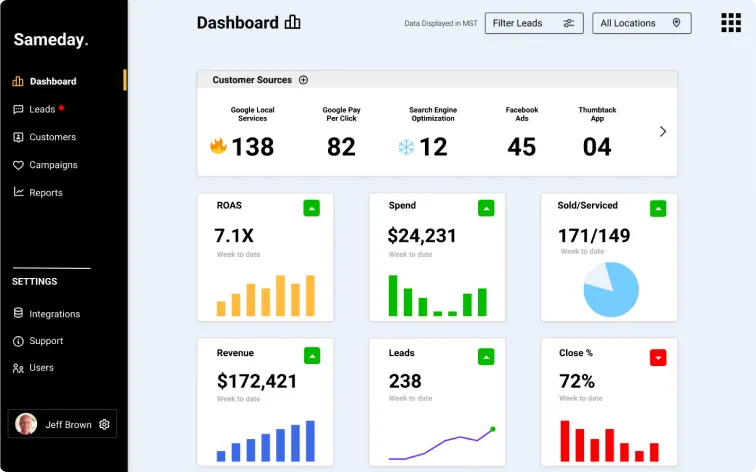
Book a demo with Sameday to see how the AI receptionist for contractors handles your calls, manages transfers, and keeps your team focused on the jobs that need them.
FAQ: AI to human call handoffs for home service businesses
What is an AI to human call handoff in home services?
It is the process by which an AI phone system, after handling the initial part of a call, transfers the caller to a live team member. A good handoff passes all the information collected during the AI portion of the call to the human, so the customer does not have to repeat themselves. For contractors and home service operators, this typically covers emergency calls, upset customers, complex requests, and high-value sales conversations.
When should an AI transfer a call to a human in an HVAC or plumbing business?
The clearest triggers are: the caller explicitly asks for a human, the situation involves an active emergency such as a burst pipe or no heat in extreme weather, the caller shows signs of frustration or distress, the request falls outside the AI receptionist's configured job types, or the call involves a high-value commercial inquiry. These triggers should be defined before the system goes live and reviewed regularly as call patterns change.
How do I set up a handoff protocol for my home service business?
Start by listing every scenario that requires a human. Then assign each one a routing destination, a salesperson, a dispatcher, a senior CSR. Confirm that your AI provider passes a full context summary with every transfer, including caller identity, call reason, what was already collected, and why the transfer was triggered. Test each scenario before going live, and track transfer rate, post-transfer booking rate, and repeat call rate weekly after launch.
How much does it cost to set up an AI phone system with proper handoff protocols for a home service company?
Pricing varies by provider and the level of integration required. The most reliable way to evaluate cost is to compare it against the revenue impact of better call handling, including calls that currently go unanswered, transfers that currently fail, and jobs that are lost because the handoff was too slow. AI answering service pricing in 2026 covers what to expect from providers and how to structure that comparison.


.svg)
.svg)