

Running a cleaning company is operationally heavy. You are managing crews, juggling recurring schedules, handling last-minute cancellations, and trying to answer calls while your team is out on jobs. The admin load is constant. And most of it does not necessarily require a human, but it just requires consistency.
That is exactly why using AI pays off for cleaning companies. It's nota tool to replace your people, but to handle the repetitive, time-consuming tasks that pull your attention away from running the business.
This article covers the specific ways AI saves cleaning companies time and money, and how to get it working in your operation.
Where cleaning companies are losing time
Before adding any tool, it helps to be honest about where the hours are disappearing.
For most cleaning companies, the biggest time drains are answering inbound calls, manually booking appointments, following up on quotes, sending reminders, and entering job data into a scheduling system. None of those tasks generate revenue on their own. They just support the work that does.
According to research from Dialzara published in December 2025, small businesses lose an average of $126,000 per year to missed calls alone, with each missed call costing $300 to $1,200 in direct revenue impact. For cleaning companies, one missed call can mean losing a client who would have booked every month.
The time spent manually managing those calls, and the revenue lost when they go unanswered, is the clearest place to start.
What does AI actually replace in a cleaning business?
A well-configured AI booking system can handle all the calls your front office currently manages manually.
That includes:
- Answering every inbound call immediately, including after hours and weekends
- Qualifying new leads with job-specific questions
- Booking appointments directly into your scheduling software
- Sending confirmation and reminder texts automatically
- Following up on quotes that have not been responded to
- Making outbound calls to confirm recurring appointments
Each of those tasks takes a real person real time when it's done manually. But an AI agent handles all of them without any human in the loop, and without making mistakes on data entry or forgetting to follow up.
How does AI phone answering work for cleaning companies?
A voice AI for cleaning companies picks up every call the moment it comes in. It greets the caller, identifies what they need, and moves through a conversation that mirrors what your best office staff would do.
For a new customer inquiry, the AI asks: what type of cleaning, residential or commercial, property size, frequency, preferred start date, and contact details. It checks availability and books the job directly into your system. The caller gets a confirmation. Your schedule gets updated. No one on your team touched it.
For an existing customer calling to reschedule, the AI pulls their record, identifies their upcoming booking, and adjusts it based on what is available. Again, no manual step required.
How AI call screening works for home services covers the full mechanics of how the AI qualifies and routes calls. The same process applies directly to cleaning companies, with the qualification questions adapted to your service types and pricing structure.
What does it cost when calls go unanswered?
Cleaning buyers, both residential homeowners and commercial facility managers, tend to call when they are free: evenings, weekends, and lunch breaks. Those are exactly the windows when most cleaning companies are least staffed.
Research from OnCallClerk's 2026 analysis of cleaning businesses found that for cleaning companies relying on on-site crews, 35% of calls during working hours go to voicemail, not because the business is closed, but because everyone is on a job. A carpet cleaning company spending $800 per month on Google Ads pays roughly $40 to $60 per inbound call. Missing 35% of those calls means hundreds of dollars in wasted ad spend every single month, before counting the lost job revenue.
Here's the solution: An automated phone system for home services runs 24/7 without gaps. The call that comes in at 7pm on a Thursday gets answered the same way as the call that comes in at 10am on a Tuesday.
How does Voice AI for cleaning companies integrate with your scheduling software?
This is where AI saves the most operational time for cleaning companies. The AI does not just answer the call. It writes directly to your scheduling platform in real time.
When a job is booked, the AI creates the record with the customer name, address, service type, date, and any relevant notes. When a job is rescheduled, it updates the existing record. When a customer cancels, it logs the cancellation and flags the open slot.
How a voice AI answering service works with CRM integration explains this workflow in detail. For cleaning companies using platforms like Jobber, Housecall Pro, or ZenMaid, the AI connects natively and writes data back without any manual entry step.
That removes one of the most common operational problems in cleaning businesses: the gap between when a call comes in and when the job appears in the system.
How does an AI Agent handle recurring clients?
Recurring clients are the backbone of most cleaning businesses. They are also the customers who call most often, for reminders, reschedules, questions about their next visit, or to add a service.
A well-configured home services AI agent recognizes existing customers when they call. It pulls their history, identifies their current schedule, and handles the request without your team having to look anything up.
For outbound recurring contact, the AI can also make automated calls or send texts before each scheduled visit, confirm the appointment, and handle any reschedule requests in real time. That reduces no-shows and keeps your schedule full without anyone on your team managing it manually.
What about quote follow-up and lead nurturing?
Most cleaning companies book the easy calls and let the harder ones go cold. A customer who asked for a quote and did not respond within 24 hours rarely gets followed up with, because the team is busy with the jobs that are already booked.
An AI handles that follow-up automatically. After a quote is sent, the system can call or text the prospect at a set interval, check whether they have questions, and invite them to book. That sequence runs without needing any input from your team. AI recovers jobs that would otherwise be lost.
How AI customer service influences booking rates for home service companies covers the data behind this. The pattern is consistent: faster follow-up and consistent outreach turns more quotes into booked jobs, at no additional labor cost.
A practical checklist for getting AI running in your cleaning business
Use this as a starting point before going live.
- Map your most common call types: New customer inquiry, existing customer reschedule, quote follow-up, recurring service question, complaint or feedback. Each one needs its own flow configured in the AI before you go live.
- Connect your scheduling software: The AI needs to write directly to your booking platform. Confirm your provider supports native integration with the software you use.
- Set your service area and availability windows: The Voice AI for cleaning companies should only book jobs you can actually fulfill. Define coverage zones, crew availability, and any blackout dates before activating.
- Configure recurring client recognition: Make sure the AI can identify existing customers by phone number and pull their service history. This is what makes the interaction feel seamless rather than generic.
- Enable after-hours coverage immediately: This is the single highest-impact change most cleaning companies can make. After-hours calls are the most commonly missed and the most commonly lost to competitors.
- Test your AI with real call scenarios: Run through a new residential inquiry, a commercial quote request, an existing customer reschedule, and a cancellation. Verify the AI handles each one correctly before forwarding your main number.
- Track booking rates weekly from day one: A properly configured AI phone answering system should book over 85% of qualified calls. If you are below that, the qualification flow needs adjustment.
For a more detailed walkthrough of the configuration process, our AI receptionist setup guide for cleaning companies covers each step in depth, including how to handle trade-specific edge cases like move-out cleans, commercial contract inquiries, and multi-location scheduling.
How can cleaning companies save costs with AI?
Let's calculate. If your cleaning business misses 15 calls per month and each missed call represents a $400 recurring monthly contract, that is $6,000 in monthly recurring revenue you are not capturing. Over a year, that is $72,000.
The cost of an AI phone answering system is a fraction of that. And unlike hiring a part-time office assistant, the AI covers nights, weekends, peak days, and sick days without any additional cost or scheduling coordination.
Research from Dialzara also found that businesses with 24/7 phone coverage improve customer retention by 24% or more, because clients know they can always reach someone. For a cleaning business built on recurring relationships, that retention lift compounds over time.
A virtual receptionist to keeps your cleaning schedule full
Your crews are good at cleaning. Your team is good at managing the work. Neither of them should be spending hours each week answering the same qualification questions, manually entering booking data, or chasing quotes that have gone cold.
A virtual receptionist built for cleaning companies handles all of that automatically, answers every call, books every available slot, follows up on every open quote, and keeps your recurring clients confirmed. Your schedule stays full. Your team stays focused. And your admin costs stay down.
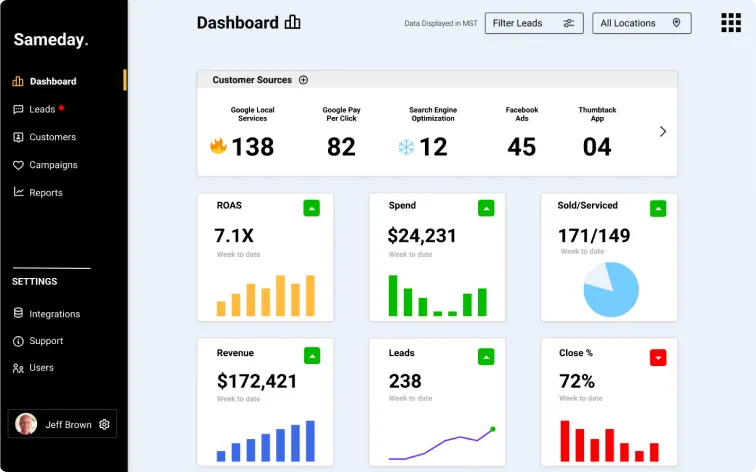
Book a demo with Sameday to see how voice AI for cleaning companies handles your calls, connects to your scheduling software, and starts booking jobs. Start saving time and money today.


.svg)
.svg)