

A burst pipe at midnight. No heat on a January weekend. An AC system failing during a heat wave. These are the calls that define a contractor's reputation, and the calls most commonly lost to voicemail.
NextPhone's analysis of 130,175 calls across 45 contractors found that 74.1% go completely unanswered. Each missed emergency call represents $500 to $900 in direct lost revenue, before counting the lifetime value of that customer or the referrals they would have sent.
For HVAC companies, plumbers, electricians, and remodelers, emergency call handling is one of the most direct levers on revenue in the business. And the way to really help your customers.
What makes an emergency answering service genuinely good for contractors?
Most AI answering services will pick up the phone. Fewer can do what an emergency call from a contractor's customer actually requires.
A real emergency answering service for contractors needs to detect urgency from natural conversation, not from a menu selection. A homeowner describing no heat with an elderly parent at home should trigger a different response than someone scheduling a spring tune-up. The system needs to understand the difference in real time, without a script forcing the caller to press buttons.
Beyond triage, the service needs to dispatch correctly. That means reaching your on-call technician immediately for true emergencies, booking the next available slot for urgent but non-critical calls, and logging everything in your field service software during the call. No callbacks for your team to make. No messages to manually enter.
For contractors covering markets with Spanish-speaking households, the service also needs to handle those calls natively. A plumber serving Houston or a remodeler in Los Angeles loses real emergency jobs every week when the answering service cannot continue the conversation in Spanish. Spanish-speaking AI receptionists have moved from optional to essential in many US markets.
What are the main types of contractor answering services?
There are three categories in the market in 2026. Each has a different cost structure, capability level, and trade-off.
Live answering services use human agents at shared call centers. AnswerForce is the most recognized trades-focused option in this category. They train agents on HVAC and plumbing workflows, offer bilingual coverage, and handle emergency dispatch reliably. Forbes named them Best Answering Service in 2025. The trade-off is cost and scale. Pricing starts at $279 per month for 200 minutes, which works out to roughly 50 calls at four minutes each. During a storm event or heat wave when call volume spikes, costs climb quickly. Integration with ServiceTitan is mostly Zapier-mediated rather than native, which means field-mapping needs to be validated before assuming a clean handoff.
Shared AI services use AI agents not purpose-built for the trades. They answer calls and take messages or follow basic scripts, but lack trade-specific emergency triage logic. A caller describing an active gas smell or a carbon monoxide alarm needs a system that recognizes those phrases as critical and acts accordingly. Generic AI services often do not.
Purpose-built voice AI for home services combines the 24/7 availability and unlimited concurrent call handling of AI with qualification logic and dispatch rules designed specifically for trades. This is the category that produces the highest booking rates in home services, and it is where the most meaningful differences between providers appear.
The best AI receptionist providers worth evaluating for contractors
AnswerForce is the strongest option in the live answering category. Real humans with trades training, emergency dispatch protocols, and bilingual coverage make it a reliable choice for contractors who want a human in the loop for after-hours emergencies. The cost structure works best for lower-volume operations where per-minute pricing does not compound into a significant monthly expense.
Smith.ai announced its ServiceTitan integration in May 2025, offering both AI and human receptionists. The service creates customer records, matches calls to existing customers, and schedules through ServiceTitan's Scheduling Pro. It is not exclusively focused on home services, which means less specialization in trade-specific workflows compared to purpose-built options.
Avoca positions itself as an AI workforce platform with a reported 27% booking rate increase for its ServiceTitan customers. It is built for larger HVAC operations with high call volumes, multiple locations, and a need for outbound campaigns alongside inbound answering. The platform is the right fit for enterprise-scale operations rather than single-location or small multi-location contractors.
Dialzara is in the AI category at a lower price point, starting at $29 per month. It covers 24/7 answering with emergency detection and works for small HVAC shops that need basic after-hours coverage at low cost. It is not a trades-specific platform and lacks the deep FSM integrations that larger operations require.
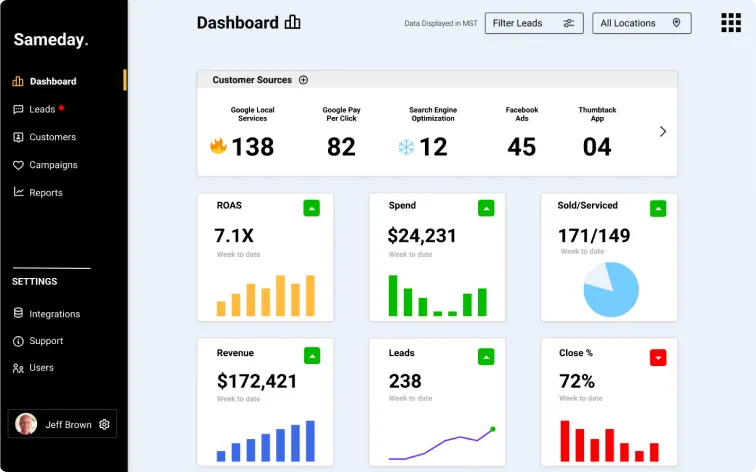
Sameday is the purpose-built option with the strongest combination of booking rate, trade-specific configuration, and CRM integration. It answers calls, responds to texts, books jobs, and dispatches directly into ServiceTitan, Housecall Pro, Jobber, and Service Fusion as an official partner of each. Across its network, Sameday reports a 92% booking rate, has handled over two million calls in the trades, and has driven $1.25 billion in revenue for its customers. Way Cool Plumbing and Air ran 4,000 calls through Sameday in four months and cited significant improvements in customer retention. For automated emergency call handling specifically, HVAC companies using the platform capture up to 40% more emergency calls by providing instant 24/7 response with automated urgency triage.
What should an emergency call answering service do for an HVAC company?
For HVAC specifically, emergency call handling has to match the reality of the trade. Most HVAC customer calls happen after 5pm, on weekends, or during weather events, exactly when standard office coverage is thinnest.
An HVAC specialty answering service needs to recognize emergency language in real time: no heat, no AC, system not turning on, carbon monoxide alarm. Each of those phrases should trigger a different response than a routine maintenance request. The AI creates emergency tickets with proper priority flags, checks the customer's service history and warranty status, and dispatches to the on-call technician immediately.
During peak season when call volume spikes 5 to 8 times the normal daily average, the answering service needs to handle unlimited concurrent calls without hold times. A homeowner who cannot get through on a 95-degree day calls the next contractor. A system that queues calls loses those jobs before the conversation ever starts.
Emergency answering service for plumbing
Plumbing emergencies are among the highest-urgency calls any contractor receives. A burst pipe or sewage backup cannot wait until Monday morning.
An AI answering service for plumbers needs to identify active water situations from the caller's description and reach an on-call technician immediately. It also needs to collect the right details during the call: where in the property the issue is, whether water is actively running, whether shutoffs have been located, and whether the property is residential or commercial. That information determines which technician to dispatch and what equipment to bring.
Plumbing emergency calls also have a higher proportion of panicked callers. The answering service needs to sound calm and controlled, guide the caller through basic safety steps if appropriate, and confirm a technician is on the way before the call ends.
How does emergency call routing work across trades?
Emergency calls require routing logic that goes beyond booking. Automated call distribution for contractors can build that routing correctly, but the principles apply across HVAC, plumbing, electrical, and remodeling.
The routing structure that works for most contractors has three tiers. Critical emergencies, which involve active safety risks or total system failure in extreme weather, go to the on-call technician immediately with a simultaneous notification to the manager. Urgent calls, where the situation is serious but not an immediate safety risk, get the first available slot with a same-day option offered. Standard calls get booked into the regular schedule.
Each tier needs its own confirmation message and follow-up sequence. A homeowner who called at 11pm about a gas smell should receive a text confirming a technician is on the way, an ETA, and a contact number. A customer who booked a next-morning service should receive a confirmation and a reminder the following day.
Electrical contractors face the same triage challenge, where electrical contractors using AI phone answering separate a tripped breaker from an active electrical hazard in real time to send the right technician.
Full call coverage for home remodeling businesses
Remodeling is a less obvious use case for emergency answering, but the need is real. A homeowner mid-renovation who cannot reach anyone when something goes wrong does not wait. They call the next contractor and often do not come back.
For remodeling businesses, a virtual receptionist for home remodeling closes that gap during the peak inquiry windows, evenings and weekends, when homeowners are planning and ready to book.
What to check before you choose a virtual receptionist provider
Before committing to an emergency answering service, ask these questions directly.
Does the AI triage emergencies from natural conversation?
Ask the provider to demonstrate how the system handles a caller saying "my heat stopped working and it is 15 degrees outside." The response should identify that as a Priority 1 situation and route accordingly, not ask the caller to select from a menu.
Does it integrate natively with your field service software?
Native ServiceTitan, Housecall Pro, or Jobber integration writes to your dispatch board in real time. A Zapier connector works but adds a step that can fail during high-volume periods.
Can it handle unlimited concurrent calls?
During a storm event, multiple emergency calls will arrive simultaneously. A system with call queuing loses those jobs. An AI Answering Service with no concurrent call limits captures them all.
What is the actual booking rate across your trade?
Any provider worth working with can show you verified booking rate data from existing HVAC or plumbing customers. A 92% booking rate across a large customer base is a meaningful signal. A provider that cannot give you trade-specific data is worth questioning.
Does it cover Spanish-speaking callers natively?
In markets across California, Texas, Florida, and the Southwest, a language barrier on an emergency call is a lost job. Make sure you have a bilingual system.
A virtual receptionist that never misses an emergency
The contractors capturing the most emergency revenue in 2026 are the ones who answer every call, triage urgency correctly, and dispatch immediately, at 2pm on a Tuesday and at midnight on a Sunday during a winter freeze.
A home service virtual receptionist built for emergency call handling does exactly that. Every call gets answered. Every emergency gets routed to the right technician immediately. Every booking lands in your dispatch board with the details already attached.
Book a demo with Sameday to get personal consulting and to see how the AI receptionist for contractors handles your emergency calls, connects to your field service software, and starts capturing jobs your competitors are still sending to voicemail.

.svg)
.svg)