

Most home service businesses are doing good work. Still they are losing some jobs.
Why?
They are losing jobs because they did not pick up the phone, took too long to respond, or let leads slip through gaps in their process.
Those are operational problems. And AI agents for home services solve them directly, not by replacing your team, but by handling the parts of the job that require speed, consistency, and 24/7 availability.
This article covers where AI creates the most revenue impact in a home service business and how to put it to work.
Where do contractors lose revenue?
Before talking about AI, it helps to be specific about the problem.
Invoca's research on home service businesses found that 27% of inbound calls go unanswered. Each missed call costs an average of $1,200 in lost revenue, before accounting for the lifetime value of that customer or the referrals they would have sent.
Run that math against your own call volume. If you receive 100 calls a month and miss 27, you are losing roughly $32,000 in potential revenue every single month. That is not a staffing problem. That is a systems problem.
Beyond missed calls, there are quieter leaks: slow response times, manual data entry that delays follow-up, leads that go cold between the call and the booked job. AI closes all of those gaps.
What can AI agents do in a home service business?
An home service AI agent is not a chatbot or a phone menu. It is a system that speaks with customers, qualifies leads, checks availability, books jobs, and logs everything to your CRM automatically.
In a home service context, the most common applications are:
Inbound call handling. The AI answers every call, qualifies the customer, and books the appointment. No voicemail, no hold time, no callback queue.
Outbound follow-up. The AI makes calls to confirm appointments, follow up on quotes, and reach out to customers who did not book on the first call.
After-hours coverage. The AI runs 24/7. A homeowner who calls about a leaking pipe at 9pm gets qualified and scheduled that night, not the next morning.
CRM sync. Every call creates or updates a record in your field service software in real time. No manual entry, no missing details, no data gaps.
How a voice AI answering service works with CRM integration covers the full workflow in detail. The short version: by the time your team looks at the schedule in the morning, the jobs are already there.
How does lead capture voice AI work for home services?
Speed is the core mechanism. A lead capture voice AI for home services picks up the call the moment it comes in. No ringing, no waiting, no voicemail.
That matters because of how homeowners actually behave. When they need an HVAC repair or a roofing inspection, they call two or three contractors at once. The first to respond wins the job, not because they are the best, but because they were there.
Research from Invoca shows that less than 3% of callers sent to voicemail during a sales interaction leave a message. The other 97% call the next number on the list.
An AI that answers in one ring captures that call. A business that goes to voicemail loses it.
How does call automation work for HVAC specifically?
HVAC is one of the highest-value use cases for an AI phone answering system. The jobs are large, the urgency is high, and the call volume spikes exactly when staff capacity is lowest.
During a summer heat event, an HVAC company might receive three or four times its normal call volume in a single day. Office staff get overwhelmed. Calls pile up. Homeowners who cannot get through call a competitor.
An automated phone system for home services handles unlimited concurrent calls. Every caller gets answered, qualified, and scheduled. The dispatch board fills up automatically. The AI handles call volume and booking. Your team handles the work and the complex customer situations that need a human voice.
What does the revenue impact with AI look like?
The clearest way to see the impact is to look at booking rates.
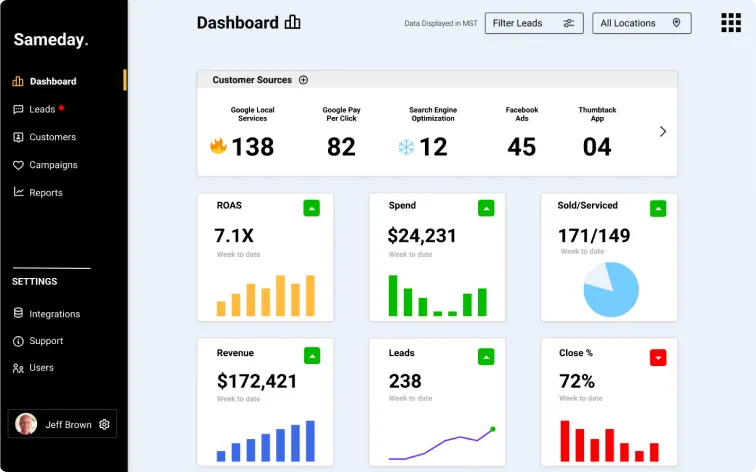
Sameday publishes booking rate data from customers across the US. Across locations in California, booking rates from AI-handled calls range from 87% to over 90%. If your current booking rate is 60% to 70%, which is typical for businesses relying on staff to answer calls, the gap represents real revenue.
According to McKinsey's research on companies deploying AI in customer-facing roles, businesses report revenue increases of 3% to 15% and sales ROI improvements of 10% to 20% after implementation. For home service businesses with strong job volume, that is not a marginal gain. It is a meaningful shift in what the business earns each year.
How does voice AI help with dispatch and job prioritization?
Booking the call is only the first step. What gets booked, and in what order, also matters.
A well-configured AI agent can identify high-value jobs, flag urgent situations, and assign the right technician based on location, availability, and skill set. That means your highest-margin jobs get scheduled first and the right tech shows up.
Automated call distribution for small contractors covers how call routing and dispatch logic work together. Getting the call answered is half the job. Getting it routed correctly is the other half.
Can a virtual receptionist replace your front office staff?
No. And that is the wrong question to ask.
The better question is: what tasks should your staff stop doing so they can focus on what actually requires a human?
Manual data entry, booking calls for jobs that have clear availability, sending appointment reminders, making happy calls after a job is done. None of those require your best CSR. They require consistency, speed, and availability at all hours. That is what AI does well.
Your staff is more valuable when they handle complex customer situations, manage escalations, and support high-value sales conversations. The best virtual receptionist for home service businesses explains how that handoff works and when to keep a human in the loop.
A practical checklist for getting started
If you want to put AI to work in your home service business, here is a clean starting point.
Audit your current call handling. Track how many calls come in, how many are answered, and what your booking rate is. You need a baseline before you can measure improvement.
Identify your highest-leak points. Is it after-hours calls? Peak season volume? Slow follow-up on quotes? The biggest gaps tell you where to start.
Choose a platform with native CRM integration. The AI needs to write directly to your field service software. A system that sends you a CSV to import manually is not solving the problem.
Configure qualification questions by job type. The AI should ask the same questions your best CSR would ask. For HVAC, that means system type, issue description, and urgency. For plumbing, it is location in the home, severity, and whether water is actively running. Trade-specific configuration is what separates a useful AI from a generic one.
Set availability rules and service area limits. The AI should only book jobs you can actually fulfill. Define your coverage area, technician availability windows, and job types before going live.
Test before you go live. Run through five to ten real call scenarios. First-time customer, existing member, after-hours emergency, billing question, reschedule request. Verify the AI handles each one correctly.
Track booking rate weekly. A well-configured AI phone answering system should be booking over 85% of qualified calls. If you are below that, the configuration needs adjustment, not the tool.
What about calls that need a human?
An AI agent should know when to transfer. If a caller is upset, the situation is complex, or the job type falls outside what the AI is configured to handle, it routes the call to a live team member immediately.
The goal is not to remove humans from customer interaction. It is to remove them from the calls that do not need them and put them on the ones that do. That is how you scale without adding headcount.
Start to optimize revenue using Artificial Intelligence
The revenue opportunity in home services is not hiding in a new marketing channel or a lower cost per lead. It is in the calls you are already getting that do not turn into booked jobs.
Answering every call, qualifying every lead, and booking every available slot without delay is what AI agents for home services were built to do. The businesses using them are not just saving time. They are converting more of what they already have.
Book a demo with Sameday to see how the AI handles your calls, connects to your field service software, and starts booking jobs from day one.

.svg)
.svg)