
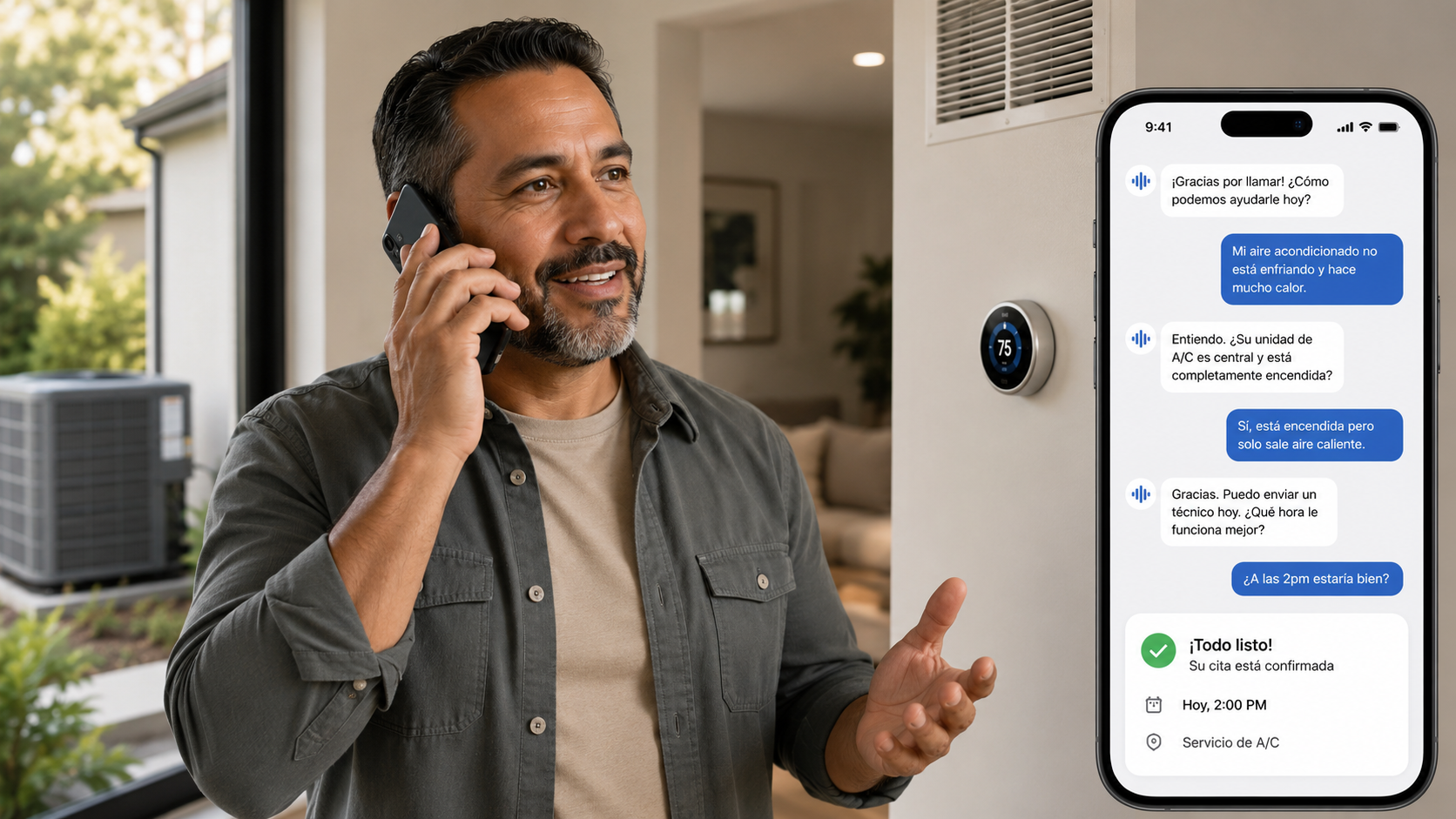
A homeowner calls your HVAC company. They speak Spanish. Your office staff speaks English - only. The call ends without a booking. That job goes to the next contractor on the list who could actually have that conversation.
This happens a lot, especially in markets across California, Texas, Florida, but also dozens of other states. And most home service operators have no idea how many calls they are losing because of it.
This article explains what multilingual customer service looks like in home services, why it matters for revenue, and how to set it up without hiring a bilingual team.
How big is the Spanish-speaking market for home services?
Bigger than most contractors realize.
According to the 2024 U.S. Census Bureau survey, 44.9 million people in the United States speak Spanish at home, making up 13.9% of the population. Hispanic homeownership has been growing steadily, with NAHREP reporting that 18.1% of all new homeowners in recent years were Latino or Hispanic.
Those homeowners need HVAC service, plumbing repairs, and home remodeling. They call contractors. And research from the Urban Institute found that 23% of Spanish-speaking households report language as a direct barrier when trying to access home services, with 34% saying they needed to bring a family member just to translate during the process.
It is clear: That is not a small edge case. In many US markets, it is a significant share of your potential customer base.
Do home service businesses lose money due to a language barrier?
The revenue impact is real and measurable.
A Common Sense Advisory study found that 75% of consumers prefer to buy from businesses that communicate in their native language, and 74% are more likely to return for repeat service when that support is available. The same research found that 64% of executives reported losing sales directly due to language barriers.
For a contractor averaging $1,500 per job, losing even five calls a month to a language barrier is $7,500 in monthly revenue. Over a year, that is $90,000 in missed work, from leads that were already calling you.
Companies that serve non-English-speaking customers in their language see revenue increases of up to 30%, according to Mindstudio's 2026 analysis of multilingual support data. That is from converting more of the calls already coming in.
How to handle multilingual calls with an AI receptionist
An AI receptionist for contractors built for multilingual service detects the language the caller is using and responds in that language automatically. No routing step, no asking the caller to hold while you find someone who speaks Spanish. The conversation continues without interruption.
For the homeowner, the experience feels seamless, almost magical. They call, they get answered in their language, they get qualified, and they book. For your business, nothing changes operationally. The job lands in your system the same way any other booking does.
Spanish-speaking AI receptionists for home service contractors covers the specifics of how that language detection and response works in practice. The key point is that the AI does not just translate. It conducts a full qualification conversation in Spanish - or another language - , asks the right trade-specific questions, checks availability, and books the job automatically.
Which industries benefit most from multilingual call handling?
Every trade that operates in markets with significant international populations benefits. But some see a more direct impact than others.
HVAC is one of the clearest cases. HVAC calls are often urgent. A homeowner with no air conditioning in July will call whoever picks up and can help them. If that conversation cannot happen in their language, they move to the next number. An HVAC specialty answering service that handles different languages captures both pools of callers during peak season without adding staff.
Home remodeling is another high-value use case. Remodeling conversations are longer and more detailed than a standard service call. The homeowner needs to describe the project, ask questions about the process, and feel confident in the contractor before booking a consultation. When that conversation happens in their first language, conversion rates improve significantly.
Plumbing and pest control follow the same pattern. Urgency is high, competition is strong, and the first contractor to have a real conversation in the customer's language wins the job.
How do you set up multilingual call handling without hiring bilingual staff?
This is where an automated phone system for home services with multilingual capability changes the game entirely.
Hiring a bilingual CSR adds $35,000 to $55,000 per year in labor cost, covers only business hours, and handles one call at a time. An AI system handles unlimited concurrent calls in multiple languages, 24 hours a day, at a fraction of that cost.
The setting up of an AI receptionist for contractors typically takes three to five days and involves:
Configuring language detection: The AI identifies the caller's language from the first few seconds of the call and responds accordingly. This happens automatically with no menu selection required from the caller.
Loading trade-specific scripts in each language: The qualification questions need to work correctly in both languages. For HVAC, that means asking about system type, the issue, and urgency in Spanish just as clearly as in English. A generic translation is not enough. The script needs to feel natural to a native speaker.
Connecting to your scheduling software: The booking confirmation and job record creation happen the same way regardless of what language the call was conducted in. The data that lands in your CRM does not change based on call language.
Testing with real call scenarios: Run through a Spanish-language HVAC call, a plumbing emergency, and a remodeling inquiry before going live. Verify the questions are natural, the booking flow works, and the confirmation message is sent in the correct language.
Learn about how AI answering services increase contractor booking rates to see the whole impact of AI call handling. Multilingual capability compounds that impact in markets where a portion of your callers currently hit a language wall and hang up.
Which languages should your Voice AI speak in the US?
Spanish is the clearest priority for most US home service businesses. But depending on your market, other languages may matter too.
In parts of California, Mandarin and Cantonese are significant. In New York and New Jersey, Portuguese, Korean, and Russian each represent meaningful populations. In Texas border markets, Spanish is dominant but not the only consideration.
The right approach is to look at your actual market data. Pull the language breakdown for the zip codes you serve, identify where you have meaningful non-English populations, and prioritize those languages in your AI configuration. Start with Spanish if it applies. Add others as volume and demand support it.
Using AI to optimize revenue for home service businesses covers how to approach this kind of market-level decision alongside other revenue optimization strategies. Multilingual call handling is one lever. It works best when it is part of a broader approach to capturing more of your inbound demand.
Combining multilingual AI with a human team
Your team does not need to speak multiple languages for this to work. The AI handles the call in the customer's language, books the job, and logs all the details in English in your system. Your dispatcher or technician sees a normal job ticket, regardless of what language the booking call was conducted in.
When a call does need to be transferred to a human, the AI passes the context to your team member in English. The dispatcher knows who is calling, what they need, and what has already been confirmed. The language of the original call does not create a gap in your internal process.
It is always useful to know how to combine AI and human strengths in HVAC for the perfect division of labor works in practice. The AI handles the volume. Your team handles the complexity. Both sides are stronger when the AI can engage with every caller, regardless of language.
Is your current phone setup missing multilingual opportunities?
Start with your call data. If you are in a market with a significant Spanish-speaking population and your booking data shows very few Spanish-language customer names or addresses in predominantly Hispanic zip codes, that gap is worth investigating.
Ask your team how often they receive calls where the caller struggles with English or hangs up quickly. Track calls where no booking results despite what seemed like genuine interest. Those are the signals that language is creating friction in your call flow.
The checklist for evaluating your phone answering service is a useful starting point for that audit. Add multilingual call handling to the evaluation criteria and use it to benchmark your current setup against what is available.
A virtual receptionist that speaks your customer's language
The home service companies capturing multilingual leads are winning jobs their competitors cannot even have a conversation about. A homeowner who calls and gets answered in their own language books faster, trusts the company more, and is more likely to become a recurring customer. Even more, they will probably recommend your service to their friends and family.
A virtual receptionist with multilingual capability answers every call, in the right language, at any hour. Your team stays focused on the jobs. The AI handles every caller who gets in touch, regardless of what language they speak.
Book a demo with Sameday to see how the AI phone agent handles multilingual calls, connects to your scheduling software, and starts booking jobs from day one.


.svg)
.svg)